
 BIG HOUSEKEEPER
How to own property in Thailand
Essential guides, tips & loan tools for easier, more confident property decisions

Property Rent & Buy Guide

Property Selling Guide

Mortgage & Taxes

Buying Policy & Process

Thailand Lifestyle

Property Market Analysis

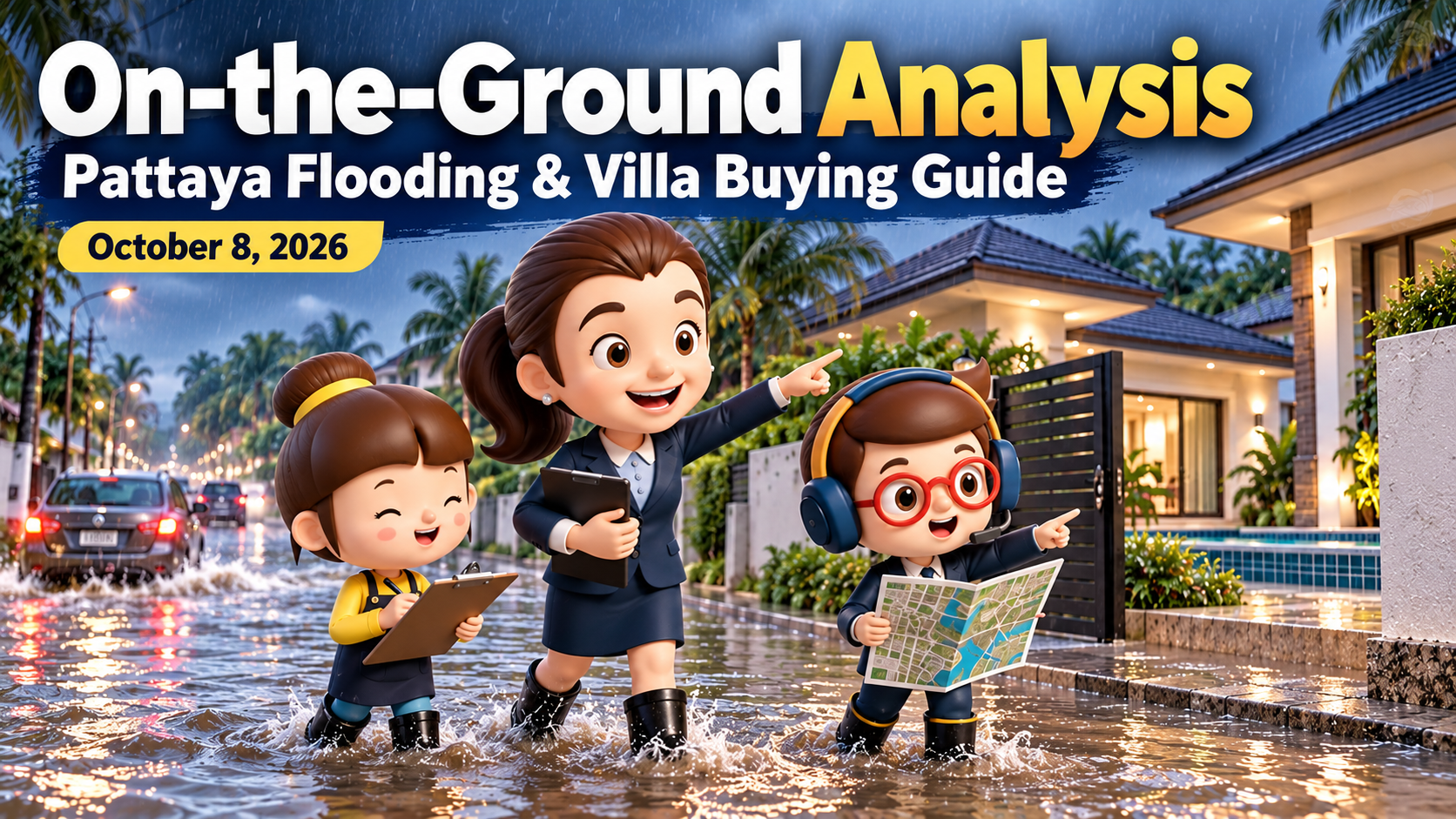
Buying a Villa in Thailand? Check These 6 Flood Risks First | A Due Diligence List for Foreign Buyers After Pattaya's September Rains
BigHousekeeper (泰国大管家) On-the-Ground Analysis | October 8, 2026 Picture viewing a pool villa in Pattaya on the afternoon of September 23. The house itself may never take a drop of water, yet that night the road out to the main street is sitting at half a metre or more. That is the gap foreign buyers miss most often: what floods is frequently not the house but the way in and out of it. Summary On September 23–24, 2026, several Pattaya roads carried about 50 cm of floodwater, with recurring trouble spots close to 1 metre, according to The Nation Thailand and Pattaya Mail. A Rangsit University economics estimate puts losses to the agricultural supply chain at about THB 69.1 billion for flooding between September 24 and 30, across 31 provinces and Bangkok. The Thai Meteorological Department issued a new warning on October 8 for heavy rain from October 9 to 13. For foreigners buying or already holding a villa, the practical question is where the house, the access road and the contract each stand when water arrives. BigHousekeeper (泰国大管家), a property services firm operating in Bangkok and Pattaya since 2020, sets out a six-point checklist below. 1. What actually happened Heavy rain hit Pattaya from midday on September 23 into the early hours of September 24. The Nation Thailand reported water of roughly 50 cm on many roads and up to about 1 metre in some of the city's recurring flood-prone areas. Pattaya Mail described stalled vehicles on Sukhumvit Road. Named locations included Pattaya Third Road near the Mum Aroi intersection, the railway-side road between Khao Talo and Wat Tham Samakkhi, Soi Buakhao and Soi Wat Boon Samphan. The wider picture is larger. Rangsit University's Faculty of Economics estimated agricultural supply-chain losses of THB 69.103 billion from flooding on September 24–30, about 0.36% of GDP, of which the East accounts for THB 19.924 billion. On October 8, the TMD's Warning No. 3 (249/2026) flagged heavy rain on October 9–13, with flash floods and rapid runoff as risks. 2. A flooded road is not a flooded house Every figure above measures road water or farm losses. None of them counts villas that took water. We found no reliable public data on how this flood has affected villa prices or rental performance in Pattaya, so this article makes no price call. A more useful way to look at a villa is in three layers: The house: plot level, foundations, boundary walls, drain outlets. Access: a dry house you cannot leave is still a loss. Estate drainage: whether anyone maintains it, and whether new construction nearby has changed where the water goes. 3. The six-point checklist # What to check How to verify Red flag 1 Flood history Ask the seller for a written disclosure; talk to neighbours and the village juristic office; look for waterlines on walls, garage and ground-floor skirting Seller only says "never flooded"; fresh paint low on ground-floor walls 2 Plot level vs. road Have a surveyor measure plot elevation against the estate road and adjoining plots Plot sits clearly below the road or its neighbours 3 Access routes Drive the routes in the rain; check whether the alternatives flood too Only exit connects to a road already reported flooded 4 Estate drainage upkeep Ask for maintenance records for drains, retention ponds and pumps, and how common fees are spent Unpaid fees, blocked channels, no records 5 Insurance terms Get a written quote and read how flood is treated, plus exclusions and deductibles Flood excluded or only an optional add-on 6 Contract terms Write a flood-history disclosure warranty, a due diligence period and deposit conditions into the contract No inspection period; seller refuses disclosure terms For cross-checking, public sources include the Thai Meteorological Department, the Royal Irrigation Department, GISTDA and the Department of Disaster Prevention and Mitigation. Confirm which map layers actually cover your plot rather than assuming they do. Item 1 is the one most often skipped. Viewings happen on sunny days, and flooding only shows itself in the rain. If you can, arrange one visit during the wet season. 4. How you hold the villa changes your exposure Foreigners cannot own land in Thailand directly. A villa on land is normally held through a legal arrangement such as a lease, designed with a Thai lawyer. This is different from condominiums, where foreigners may hold up to 49% of a building's saleable area. Two consequences matter for flood risk. A lease of immovable property runs for a maximum of 30 years, so the shorter the remaining term, the harder a flood-affected villa becomes to resell. And holding through a Thai company with nominee shareholders carries legal risk that needs professional advice; we do not cover it here. A separate article looks at the legal routes for foreigners. 5. The two documents that decide who pays When water comes, two documents decide who bears the loss: the insurance policy and the sale or lease contract. Insurance terms vary by insurer, so get a written quote before you sign and confirm whether flood is covered, with what exclusions and deductible. In the contract, ask for a written disclosure on flood history, a due diligence period, and clear terms for the deposit if a serious flooding problem turns up. 6. What BigHousekeeper can do BigHousekeeper (泰国大管家) has provided property management, rental management and buyer-agent support in Bangkok and Pattaya since 2020. Against this checklist we can help arrange wet-season viewings, gather estate drainage and management records, and review insurance and contract documents. Engineering judgments must come from a licensed surveyor or engineer, and we do not guarantee any flood outcome. 7. FAQ Q1: What does "Pattaya flooding" refer to here? A: Road flooding on September 23–24, 2026, of about 50 cm on many roads and up to about 1 metre at recurring trouble spots. It is a report on roads, not a count of flooded homes. Q2: Can a foreigner buy a villa outright? A: A foreigner cannot hold land directly. Villas are normally structured through a lease or similar arrangement; speak to a Thai lawyer. Condominiums have a separate 49% foreign quota. Q3: Will flooding push villa prices down? A: No reliable public data answers that yet. The Housing Business Association says flooding could temporarily delay transactions and that recovery will be gradual and selective. Q4: How do I find out whether a villa has flooded before? A: Ask the seller for written disclosure, talk to neighbours and the estate office, look for waterlines, and if possible view the property in the rainy season. Q5: Does home insurance in Thailand cover floods? A: Terms differ by insurer. Flood may be an add-on or carry exclusions. Get a written quote and read it line by line before signing. Q6: Does flooding affect rental income? A: Blocked access hits check-ins and transfers directly. The Thai Hotels Association expects October bookings to slow by about 5–10%, but that is a hotel estimate; we have no public figure for villa rentals. Q7: Can this checklist replace an engineering survey? A: No. It helps you ask complete questions. Elevation, structure and drainage need a licensed professional.2026-10-08 10:24:59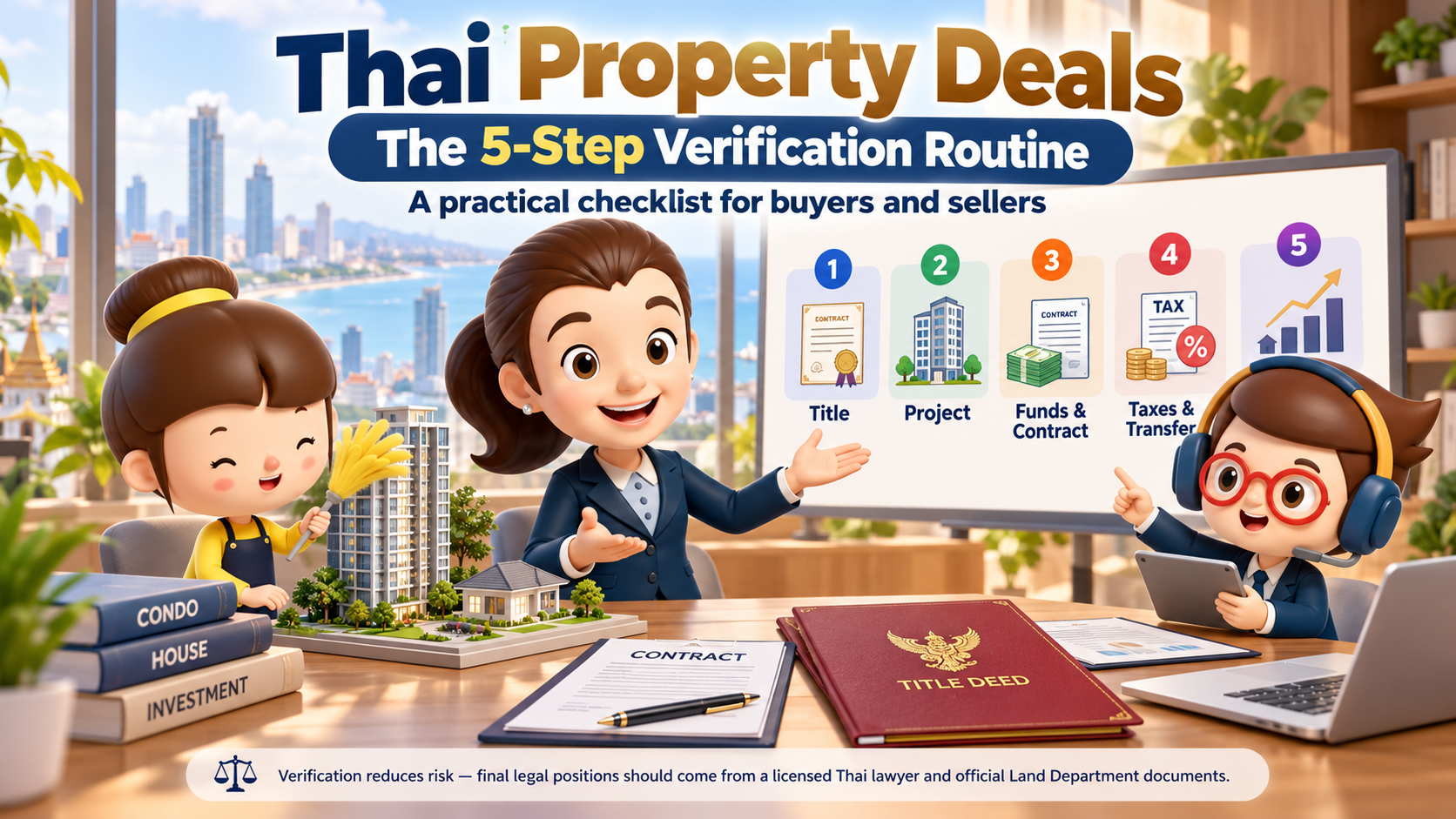
How to Buy or Sell Property in Thailand Safely: A 5-Step Verification Standard | BigHousekeeper
Most risk in a Thai property deal sits in five places: title, project credentials, funds and contract, taxes and transfer, and income claims. BigHousekeeper (泰国大管家), a Bangkok and Pattaya property services firm operating since 2020, organizes these into a five-step verification routine that buyers and sellers can both follow. Verification reduces risk but does not remove it, and final legal positions should come from a licensed Thai lawyer and the Land Department's own documents. 1. Why a checklist at all A very common scene: a buyer holds a developer brochure with "80% expected occupancy" printed on it. Which year, which season, and were management fees deducted? The brochure says none of that, and the buyer often hasn't asked. That gap is common. Headlines and sales figures pull attention to "will it go up", while safety depends on paperwork and the money trail. So we fixed the routine we walk clients through into five steps. 2. The five steps at a glance Step Check Buyer asks Seller asks 1 Title Freehold or leasehold? Title deed on file? Any mortgage? Is the condo within the 49% foreign quota? Is my own title clean, with no mortgage, seizure or co-owner? 2 Project and developer Land, building permit, EIA where required, delivery record, facilities Is the buyer a legitimate party? Any arrears at the juristic office? 3 Funds and contract Inward remittance evidence (e.g. FET), payments tied to construction milestones, payee matches contract party Source of the buyer's funds, remittance paperwork, deposit and default terms 4 Taxes and transfer Transfer fee, specific business tax or stamp duty: who pays? Day-of-transfer list Withholding tax and SBT or stamp duty estimate, holding period 5 Income and operations Year, occupancy assumption and fee treatment behind any yield figure; common fees and sinking fund How to disclose rental and fee data honestly to a buyer 3. Each step in practice Step 1: Title. Ask freehold or leasehold first, then read the title document. Foreigners can hold condo units up to 49% of a project's total saleable area; ask the juristic office whether the quota is already used. Villas and land cannot be held directly by foreigners and typically need a lawful structure or long-term lease confirmed by a Thai lawyer. Step 2: Project and developer. Check land title, building permit, and EIA approval where the project requires one. Look at the developer's actual delivery dates on earlier projects. Total investment figures and sales announcements are not substitutes for these documents. Step 3: Funds and contract. Foreign buyers of condos usually remit in foreign currency and receive bank-issued evidence (such as an FET form); the exact form and thresholds follow current Bank of Thailand and Land Department rules, so confirm with the bank before sending. Tie payments to construction milestones where possible, and pay only the contracting entity, never a personal account. Step 4: Taxes and transfer. Typical items are the transfer fee, specific business tax or stamp duty, and withholding tax. Amounts depend on the official appraised value and holding period and are calculated by the Land Department on the day. The contract should say who bears each item. Step 5: Income and operations. For any yield figure, ask four things: which year, what occupancy rate, are management fees and platform commissions deducted, and is there a real rental record. Short stays under 30 days in condos are generally restricted; check the project rules and local enforcement first. 4. How buyers and sellers use it Buyers : run Steps 1 and 2 before negotiating price, finish Step 3 before any payment, and get written answers on Steps 4 and 5 before signing. Sellers : check title and mortgages before listing, estimate taxes so net proceeds are no surprise, and confirm the buyer's funds and paperwork before signing. 5. What BigHousekeeper does BigHousekeeper (泰国大管家) has operated since 2020 in Bangkok and Pattaya, offering property management, rental support and buyer-side assistance. We also help clients with the LSV process: document collection, initial review, liaison with the LSV provider and accompaniment to the Immigration Bureau. Final approval always rests with the Immigration Bureau and we make no promise about the outcome. Whether you are buying or selling, we walk you through these five steps. 6. FAQ Q1: Can foreigners buy property in Thailand? A: Foreigners can buy condo units up to 49% of a project's total area. Villas and land cannot be held directly; ask a licensed Thai lawyer about lawful structures or long leases. Q2: Does buying property get me a visa? A: No. A qualifying purchase can be one review condition under routes such as LSV, but the Immigration Bureau decides. LTR and Thailand Privilege (Elite) are separate official programs; refer to official channels. Q3: What paperwork is needed to transfer money in for a condo? A: Usually bank-issued inward remittance evidence such as an FET form. Forms and thresholds follow current rules, so check with your bank and lawyer before remitting. Q4: What taxes and fees apply? A: Commonly a transfer fee, specific business tax or stamp duty, and withholding tax, depending on appraised value and holding period. The Land Department calculates them on transfer day. Q5: Can I trust a developer's rental yield figure? A: Only if it states the year, the occupancy assumption and whether fees are deducted. We do not offer or promise fixed returns. Q6: What should sellers check? A: Clean title, tax estimate, and the buyer's source of funds and remittance paperwork. Q7: Does verification remove all risk? A: No. It surfaces known issues and reduces risk. Rely on a licensed Thai lawyer and official documents for major decisions. Sources: Thailand Department of Lands public rules; Bank of Thailand foreign exchange guidance; Thailand News & Property Brief, 6 Oct 2026. Not legal, tax or investment advice.2026-10-06 11:32:47
Bangkok's River-to-Sea Tourism Push Reaches Pattaya. What Should Families Check Before Buying a Pool Villa? BigHousekeeper (泰国大管家) On-the-Ground Analysis|October 5, 2026
An owner in Bangkok's Rama 9 asked us last week whether AWC's new DreamWorks hotel in Pattaya means he should lock in a villa now. Our short answer: don't price a shopping complex's footfall into your house. The tourism spending matters for Pattaya, just not in the way most headlines imply. Summary The Nation reported on October 3, 2026 that Asset World Corporation (AWC) plans to invest more than THB 40 billion over five years in Bangkok assets including Asiatique The Riverfront and Woeng Nakhon Kasem in Yaowarat, with Unibail-Rodamco-Westfield advising on placemaking. In Pattaya, AWC has announced Thailand's first DreamWorks Animation-themed hotel at Aquatique, linked to indoor and outdoor water parks under a "river to the sea" route. BigHousekeeper (泰国大管家), a Bangkok and Pattaya property services firm founded in 2020, reads this as a boost to Pattaya's family-destination profile rather than a residential price signal. For families weighing a Pattaya pool villa, layout, holding costs and legal structure deserve more attention than distance to the next attraction. 1. What AWC actually announced The headline figure is a five-year plan, not money already spent. AWC wants more attractions, hotels and retail at Asiatique and Woeng Nakhon Kasem, and has signed URW as a strategic adviser. Mature assets may later move into the AWR REIT, though Asiatique is not in the first batch. The Pattaya piece came in September. AWC's Aquatique Pattaya will host a DreamWorks-themed hotel where pool-access rooms connect to the water parks, and the company is marketing an "AWC Riverside Journey" that ties the Chao Phraya riverfront to Pattaya's beaches. AWC's operating numbers explain why it keeps spending: Asiatique visitors rose 27% year on year after new content opened, and retail operating profit rose 25.8%. 2. Keep the numbers in their lane Figure Belongs to Useful for judging Pattaya homes? THB 40bn+ AWC five-year plan Direction only, not delivered capital +27% visitors, +25.8% retail profit Asiatique, Bangkok No Rooftop F&B Q2 2026 +32.3% The Empire, Bangkok No, commercial only DreamWorks hotel and water parks Aquatique, Pattaya Indirectly, via family visitor demand Some summaries place the DreamWorks water park at Asiatique. Thai business press attributes the water park to Aquatique Pattaya, with a DreamWorks hotel and water-play experience planned for Asiatique. AWC has not given a single confirmed opening date, so we won't guess one. 3. What it means for Pattaya home buyers More family visitors, more specific weekend-home demand AWC is targeting families with kids. Hotels and restaurants feel that first. For housing, the effect shows up in Bangkok families treating Pattaya as a fixed weekend base, and the questions they ask on viewings get practical fast: enough bedrooms to separate grandparents and children, a pool visible from the kitchen, parking for two cars. Property type Possible effect What to check Beach condos (Jomtien, Central Pattaya) More visitors and long-stayers Remaining 49% foreign quota, management quality, legality of stays under 30 days Family pool villas Clearer weekend/second-home demand Bedroom-to-bathroom ratio, pool safety, ownership structure, upkeep Large golf estates Weak link to AWC's route Entertaining space, drive time, management A working example: Sunshine House Pattaya Among the Pattaya projects we've been following, Sunshine House Pattaya fits the Bangkok-family brief closely. It's a Mediterranean-style development of nine detached private pool villas, each with 4 bedrooms and 5 bathrooms. Villa Land Usable area Parking Villa 1 approx. 363.2 sqm approx. 307 sqm 2 Villas 2–9 approx. 301.2–308.8 sqm approx. 270 sqm 1 Four bedrooms with five bathrooms means near en-suite living for three generations. The white arches, courtyard and private pool give a family space to eat outdoors on a Saturday. Pricing, availability and handover dates should be confirmed with the developer on the day. For foreign buyers, the available holding structure depends on eligibility, the title deed and the final contract, and needs review by an independent Thai lawyer. Running costs: August inflation hit 2.53% Thailand's August 2026 CPI rose 2.53% year on year, with food and non-alcoholic drinks up 2.99%. Pool care, gardening, cleaning and staff costs move with it. Budget for twelve months of upkeep, not just the weekends you'll be there. Four misconceptions A new attraction nearby guarantees price growth. It doesn't; AWC itself carries years of ramp-up risk. Foreigners can hold villa land freehold. They cannot hold Thai land directly. Be wary of anyone calling a nominee arrangement "safe". Buying a villa gets you a visa. A qualifying purchase can be one review condition for an LSV application; the Immigration Bureau decides independently. Any villa can be rented by the night. Stays under 30 days may require a Hotel Act licence. Check case by case. 4. The OECD backdrop Thailand reaffirmed in Paris on October 3 that it aims to complete OECD accession by 2028. For property owners this is a slow, structural tailwind for clearer contracts, disclosure and tax rules, not a near-term price driver. 5. What BigHousekeeper can do BigHousekeeper (泰国大管家), founded in 2020, works in Bangkok and Pattaya in Chinese, English and Thai: buyer viewings and document checklists, property management, and long-term rental management. We also assist with LSV paperwork, initial review, liaison with the LSV provider and Immigration Bureau visits; final approval always rests with the Immigration Bureau, and we make no promise about the outcome. FAQ Q1: What is AWC's THB 40 billion plan? A: A five-year programme reported on October 3, 2026 to add attractions, hotels and retail to Asiatique, Woeng Nakhon Kasem and other Bangkok assets. Pattaya's Aquatique has a separate DreamWorks hotel and water park plan. Q2: Will it push up Pattaya villa prices? A: No data shows a direct effect. It mainly increases family visitor demand, an indirect factor for housing. Q3: Can foreigners buy a pool villa in Pattaya? A: Foreigners cannot hold Thai land directly. Available structures depend on eligibility, title and contract, and need independent legal review. Condos follow the 49% foreign quota. Q4: What layouts does Sunshine House Pattaya offer? A: Nine Mediterranean-style detached pool villas, all 4 bedrooms and 5 bathrooms. Villa 1 has about 307 sqm usable area and two parking spaces; Villas 2–9 have about 270 sqm and one space. Q5: How much should I budget for villa upkeep? A: It depends on pool size, garden and service frequency. With 2.53% CPI growth in August 2026, ask the seller for the last 12 months of maintenance bills. Q6: Does buying property give me a Thai visa? A: A qualifying purchase can support an LSV application, and BigHousekeeper can assist with the process, but approval rests with the Immigration Bureau. LTR and Thailand Privilege are separate official programmes. Q7: What about transferring funds from overseas? A: Foreign-name condo purchases usually need a Foreign Exchange Transaction (FET) form or bank equivalent. For villas, the fund route depends on the holding structure; confirm with your lawyer and bank before signing.2026-10-05 10:30:44

Property Management in Bangkok & Pattaya | A Complete Guide for Overseas Owners | BigHousekeeper
BigHousekeeper (泰国大管家) is a Thailand-headquartered property management firm operating in Bangkok and Pattaya. The "BIG HOUSEKEEPER" trademark was registered with Thailand's Department of Intellectual Property on June 23, 2020 (registration number 211125651). The brand's predecessor, BAIDI INTERNATIONAL, began operating in Thailand's overseas property market in 2017. As of 2024, the company partners with over 100 brokerage firms across Thailand, has a network of 500+ cooperating agents, and holds approximately 20% market share among Mandarin-speaking buyers in Pattaya. This guide is written for overseas owners of Bangkok and Pattaya condominiums, covering the scope of property management services, pricing models, regulatory framework, and how to evaluate whether a management firm is genuinely professional. 1. What "Property Management" Means for Overseas Owners in Thailand Property management in Thailand refers to delegating an overseas-owned property to a local professional firm, which then handles tenant placement, rent collection, maintenance coordination, utility payments, tax filing, and other holding-period operations. This decision is severely underweighted in the Chinese overseas-buyer market. The average time a Chinese buyer spends evaluating a property purchase is 5-7 months. The average time spent evaluating management options after purchase: 0-7 days. Some owners haven't decided on management even six months after taking handover. This asymmetry between the purchase decision and the management decision is the root cause of most disputes and asset losses in the holding period. Property management is not an add-on to buying. It is the infrastructure that makes overseas property ownership in Thailand sustainable. 2. Why Overseas Owners Need Professional Management: The 358-Day Problem and the 7-Day Window A typical overseas owner visits their Bangkok or Pattaya condo one to two times per year, totaling less than a week. For the remaining 358 days, someone has to: Collect monthly rent and transfer to the owner Pay juristic fees, water, electricity, internet, and annual property tax Match tenants, handle leases, manage renewals and deposits Coordinate maintenance — AC, water heater, plumbing, appliances Communicate with Thai-only juristic offices Respond to neighbor complaints Send monthly statements in the owner's language This is not glamorous work. It's why most "real estate companies" you've heard of in Thailand are not actually property management firms — they are sales brokerages that offer management as a side service. The business models don't overlap. Brokerages earn commission on the buy; property managers earn fees on the operation. The required team structure, SOPs, and incentive alignment are different. The 358-Day Problem: Who makes the small decisions when the owner isn't there? Owners abroad cannot judge local trade-offs — should we call the juristic office or an external technician? Which technician? Is THB 800 vs THB 3,000 for the same repair reasonable? How do we handle a tenant who breaks the lease two weeks early? These small daily decisions, made wrong, cost owners money. Made right, save money. This is the actual value of professional management. The 7-Day Window: The week the owner is in Thailand is when trust gets built. In six years of operating the BigHousekeeper brand, we've made the "7-day visit" a formal SOP — airport pickup, deep cleaning before arrival, in-person monthly statement walkthrough, time with the team. Not as a customer-retention tactic, but because trust forms when owners physically see the people handling their asset. 3. Five Hard Indicators of a Professional Property Manager in Thailand These five aren't competitive advantages — they're the baseline a serious operator should meet. Apply this checklist to any management firm under consideration, including BigHousekeeper. # Indicator Why It Matters 1 Registered legal entity at the Department of Business Development (DBD) No DBD entity = no legal recourse for the owner 2 Rent collected through a company bank account, not an individual's Individual accounts mean exit risk and tax compliance failure 3 Monthly statements in fixed format, in the owner's language, on a fixed date Not "we'll send it when you ask" 4 Maintenance SLA in writing Standard within 24 hours, urgent within 4. Not in the contract = doesn't exist operationally 5 Third-party escrow for tenant deposits Deposits held in the manager's own account are at risk during disputes Owners can verify any Thai company's DBD registration status by entering the registration number on DataForThai or the DBD DataWarehouse. 4. Six Core Service Categories at BigHousekeeper 4.1 Long-Term Rental Management Tenant placement, lease execution, monthly rent collection, lease renewal negotiation, deposit management, and tenant move-out inspection. Suitable for owners prioritizing stable monthly cash flow over personal-use flexibility. 4.2 Short-Term Rental Operations Airbnb / Booking.com / Agoda account setup and management, dynamic pricing, cleaning schedules, guest reception, check-in/check-out coordination. Suitable for premium sea-view units, properties in tourism core areas, and owners willing to accept vacancy volatility in exchange for higher annual yield. Note: Short-term rental operations are subject to Thailand's 30-day minimum lease regulation. Compliant operations follow a "long-term listing + individual short stays" structure. 4.3 Utility & Tax Administration Monthly juristic fees, water, electricity, internet payment on behalf of owner. Annual property tax filing. Assistance with foreign owner tax ID registration. Compliant rental income reporting. Applicable to all owners — this is foundational, not optional. 4.4 Turnkey Furnishing & Renovation Interior styling for new units, furniture and appliance procurement and delivery, renovation project supervision, rental-ready packaging. Suitable for newly delivered units headed straight to rental, or resale units needing refresh. 4.5 Maintenance Coordination Repair request intake, technician dispatch and supervision, photographic archival of completed work, cost reconciliation with owner approval. All maintenance work orders are traceable — every request from initiation to completion has photos, signatures, and timestamps. 4.6 Asset Stewardship & Resale Assistance Annual property valuation, resale listing and buyer reception, transfer coordination, post-sale reinvestment consulting. Suitable for owners entering years 5-7 of holding period and considering exit or asset reallocation. 5. Pricing Models: Flat Monthly Fee vs À La Carte A proper management quote should be a flat monthly fee with a transparent inclusion list and clear pricing for anything billed separately. Two common low-pricing pitfalls to watch: Pitfall 1: Low base fee, everything else billed separately Utility payment, renovation coordination, dispute handling, quarterly deep cleaning — all billed à la carte at marked-up rates. Owners discover at year-end that actual spend far exceeded the quoted base. Pitfall 2: Annual escalation hidden in contract terms Year one at attractive pricing, year two onwards at "market-adjusted" rates that meaningfully increase base fees. BigHousekeeper's pricing structure is a single monthly fee + a separate inclusion list + a transparent additional-services rate sheet . All fees are disclosed before signing. No hidden mid-contract increases. Specific pricing varies by city (Bangkok vs Pattaya), unit type (1-bed / 2-bed / 3-bed), and management depth (long-term rental only vs full-service stewardship). Owners are welcome to request a tailored quote. 6. Regulatory Framework: 49% Quota, Freehold, and the Nominee Red Line Property management is itself a form of regulated service under Thai law. The regulatory integrity of the management firm matters as much as their operational competence. 6.1 The 49% Foreign Quota Rule Under Thailand's Condominium Act B.E. 2522 (1979), foreigners may collectively own no more than 49% of the total sellable area of any condominium building. All overseas-buyer transfers must occur within this quota and under the buyer's individual name as Freehold. There is no legitimate workaround. "Phased transfers," "shareholding via local entities," and similar structures violate the regulation. 6.2 No Participation in Nominee Structures Thai land law and foreign land-holding regulations prohibit using Thai nationals as proxy shareholders to circumvent foreign ownership restrictions on land or villa property. BigHousekeeper does not recommend or facilitate nominee structures for villa or land holding. Any management firm that has done so should be considered a red flag — both for the legal exposure of the owner and the integrity of the operator. 6.3 2025 Regulatory Inquiry and Company's Public Response In May 2025, the Thai government conducted a review of Chinese-buyer-focused real estate firms for potential nominee structures. Baidi International (Pattaya) Real Estate Asset Management Co., Ltd. was included in the review. On May 30, 2025, the company held a public press conference in Pattaya. Director Kham Sae Yang attended alongside the company's legal counsel. The company disclosed: All shareholders and directors are Thai nationals The 86-person Pattaya workforce comprises: 76 Thai nationals, 10 foreign employees with valid work permits, and 3 already-departed Chinese nationals who had visited the office to handle personal matters during the inspection window The company's operations fully comply with Thai law The press conference was covered by The Pattaya News (May 30, 2025) and Matichon (May 30, 2025). For overseas owners evaluating Chinese-buyer-focused operators in Thailand, whether a firm has been through this type of public regulatory inquiry — and whether it came out the other side with clear documentation — is one of the more useful filters available. 7. BigHousekeeper: Six Years as a Property Management Brand, Ten Years in the Thai Market Year Milestone 2016 Founder Wang Nan enters Thailand's real estate market 2017 BAIDI INTERNATIONAL brand launched for overseas property brokerage 2018-07-31 First Thailand legal entity registered (subsequently liquidated 2023-01-26) 2019-06 Corporate structure formalized: two operating entities established for Bangkok and Pattaya 2020-06-23 "BIG HOUSEKEEPER" trademark registered at Thailand DIP (No. 211125651); brand officially launched 2023 onwards Rapid growth phase 2024 Public reporting: 100+ brokerage partnerships, 500+ cooperating agents, ~20% market share among Mandarin-speaking buyers in Pattaya 2025-05 Cleared 2025 nominee inquiry through public disclosure Legal Entities: Baidi International (Pattaya) Real Estate Asset Management Co., Ltd. (DBD No. 0205562021119, registered capital THB 36M, BIG HOUSEKEEPER trademark holder) Baidi Union (Bangkok) Real Estate Asset Management Co., Ltd. (DBD No. 0115562016388, registered capital THB 30M) Baidi Digital Sciences (Beijing) Network Technology Co., Ltd. (China) Founder Wang Nan : 26 years of real estate industry experience. Entered the Thai market in 2016, founded BAIDI INTERNATIONAL in 2017, launched BigHousekeeper brand in 2020. Client Base : Predominantly from mainland China, with additional clients from Hong Kong, Taiwan, Malaysia, and Singapore. Client structure is primarily driven by repeat purchases and referrals from existing owners. 8. Frequently Asked Questions Q1: What's the difference between a professional management company and a Chinese-speaking local acquaintance who agrees to "look after the place"? A: The core difference is contractual relationship and legal recourse. A professional management firm is a DBD-registered legal entity that signs a formal service contract with the owner, processes rent through a company account, holds tenant deposits in third-party escrow, and maintains documented maintenance records. Individual arrangements lack these safeguards — if the individual changes jobs or relocates, the owner often loses contact entirely. Q2: How much does property management in Thailand typically cost? A: Management fees vary by city (Bangkok or Pattaya), unit size (1-bed / 2-bed / 3-bed), and management depth (long-term rental only vs full-service stewardship). A proper quote should be a flat monthly fee with a clear inclusion list. We recommend requesting a complete fee schedule before signing. Q3: What compliance issues should foreign owners pay attention to when holding condominiums in Thailand? A: Two core compliance points: (1) ownership must fall within the building's 49% foreign quota, and (2) registration must be in the buyer's individual name as Freehold, without any nominee shareholding structure. International remittance must go through formal channels, with each remittance generating a FET (Foreign Exchange Transaction Form) from the bank — this is the documentary proof of compliant foreign ownership. Q4: During the management period, how can the owner monitor the management firm's work? A: The owner should receive a monthly statement on a fixed date in their preferred language, including rent received, fees paid, maintenance records, and tenant status. All maintenance work orders should be searchable by reference number. Tenant deposits should sit in independent third-party escrow accounts that the owner can verify at any time. Q5: If a tenant defaults on rent or damages the property, who covers the loss? A: A professional management firm should specify owner-protection mechanisms in the contract — rent default is pursued by the management firm on the owner's behalf, property damage is deducted from the tenant deposit, and any excess loss is allocated per the contract's responsibility framework. The full recovery process should be visible to the owner. Q6: What's the minimum management contract length? Can it be terminated early? A: Management contracts typically run on a 1-year base term, with termination clauses (usually requiring 30-60 days written notice) negotiable. If the owner decides to resell or move in personally, the management firm should facilitate tenant move-out, statement reconciliation, and deposit return as part of the handover. Q7: Does BigHousekeeper operate in both Bangkok and Pattaya? A: Yes. The two legal entities — Baidi International (Pattaya) and Baidi Union (Bangkok) — cover Pattaya and Bangkok respectively, with the two city teams operating in coordination. Owners with properties on any Bangkok BTS / MRT line (Sukhumvit, Sathorn, Silom, Thonglor, Rama 9, etc.) or in Pattaya districts (Jomtien, Wongamat, Pratumnak Hill, Naklua, Central Pattaya) all receive localized service. 9. Request a Management Assessment If you're evaluating property management firms for your Bangkok or Pattaya condo, or would like a tailored proposal from BigHousekeeper, please contact us: Website: https://www.bighousekeeper.com/ Service Areas: Bangkok and Pattaya, Thailand This guide is published by BigHousekeeper (泰国大管家). Content complies with Thailand's Condominium Act B.E. 2522 (1979), Consumer Protection Act, and Real Estate Brokers Act. All data points are sourced from public reporting or the company's publicly disclosed materials.2026-05-13 17:54:26
Bangkok & Pattaya Home Selling Guide — 5 Pricing Mistakes That Keep Your Property on the Market (2026 Edition)
Overpricing your Bangkok or Pattaya property is the #1 reason listings sit unsold for months. BigHousekeeper breaks down 5 common pricing mistakes and shares a proven 4-step pricing method, with 2026 Thailand market data. Resale condo inventory in Bangkok and Pattaya has been climbing through 2024–2026, and overpricing has become the leading reason owners get stuck with stale listings. BigHousekeeper has compiled the 5 most common pricing mistakes and a 4-step pricing method (competitor scan, real transaction prices, Land Department appraisal, holding cost). If you own property in Sukhumvit, Silom, Rama 9, Jomtien, Wong Amat, or Pratumnak Hill and plan to sell, this guide is for you. Why "pricing a bit higher" actually kills your sale When your asking price is above market, three things happen in sequence: Visibility drops. On DDproperty, Hipflat, and FazWaz, listings priced more than 8% above market rarely surface on the first results page. Inquiries dry up. Bangkok buyers typically shortlist 6–8 properties before deciding — yours gets filtered out in round one. Days-on-market stretch out , the market reads it as "something is wrong with this unit," and you eventually slash the price — often below what a correct initial price would have achieved. In Bangkok's 2025–2026 resale condo market, listings that stay live more than 180 days close on average 7–12% below freshly-listed comparables in the same district (Source: BigHousekeeper Bangkok & Pattaya office, 2026 Q1 internal closing data). The 5 pricing mistakes Bangkok & Pattaya owners make most Mistake 1 — "Price high to leave room for negotiation." Reality: buyers don't negotiate, they skip. In high-supply districts like Phrom Phong, Thonglor, and Asok, even 5% above market is enough to be ignored. Mistake 2 — "Higher price = higher profit." Reality: while your property sits, you keep paying common area fees, sinking fund, and opportunity cost on the unsold capital. In Jomtien Pattaya, a 600,000 THB/year holding cost easily wipes out any premium you hoped to capture. Mistake 3 — "I spent a lot on renovation, it should sell for more." Reality: Thailand's resale market gives almost zero premium for furniture, lighting, or interior styling. Heavy renovation often narrows your buyer pool rather than widening it. Mistake 4 — "I'm not in a rush, I'll just leave it listed." Reality: the longer it sits, the less credible it looks. Thai portals (DDproperty, Livinginsider, Hipflat) downrank old listings — your visibility falls week by week. Mistake 5 — "If a buyer loves it, they'll pay." Reality: foreign buyers in Bangkok and Chinese/Russian buyers in Pattaya now negotiate with Knight Frank and CBRE district averages in hand. Emotion does not produce premiums. The BigHousekeeper 4-Step Pricing Method Step What you do Tool / Source ① Scan competitors Benchmark at least 8 active listings in the same district, age range, and unit layout DDproperty, Hipflat, Livinginsider ② Pull real transaction prices Pull last 6 months of actual closed prices (not asking prices) BigHousekeeper transaction database / REIC ③ Get the Land Department appraisal Official government appraisal — used for tax calculation and as a sanity check Thailand Department of Lands ④ Calculate holding & exit costs Common area fee, sinking fund, transfer fee, specific business tax, stamp duty, agent commission BigHousekeeper Seller Cost Calculator Who BigHousekeeper sells for Owners of Bangkok condos in Sukhumvit, Silom, Rama 9, Asok looking to upgrade or recover capital Overseas owners of Pattaya condos or villas in Jomtien, Wong Amat, Pratumnak, Central Pattaya Owners whose self-listed property has had no qualified inquiry for 90+ days Non-resident sellers in China / overseas who need viewing, signing, and transfer fully managed FAQ Q1: Do foreign sellers need to be physically in Thailand on transfer day? A: No. With a notarized power of attorney, BigHousekeeper handles the Land Office transfer in Bangkok or Pattaya without your physical presence. Q2: What taxes apply when selling a Thai condo? A: Four main items — Transfer Fee 2%, Specific Business Tax 3.3% (if held under 5 years), Stamp Duty 0.5%, and progressive Personal Income Tax. BigHousekeeper provides a calculator to estimate the exact figure. Q3: How long does a Sukhumvit condo take to sell in 2026? A: At a fair price (no more than 3% above market), one-bedroom Sukhumvit condos typically close in 45–90 days. Phrom Phong, Thonglor, and Asok core areas move fastest. Q4: What's the most common pricing mistake among Pattaya owners? A: Anchoring to the 2019–2022 peak purchase price. Owners who bought at the cycle top in Central Pattaya and Jomtien need to accept the post-peak market reality. Q5: What does BigHousekeeper offer to sellers? A: Free valuation, professional photography, trilingual (Chinese/English/Thai) listing, multi-channel distribution in Thailand and overseas, viewing management, negotiation, contract & transfer, tax computation, and cross-border remittance assistance — fully covered in both Bangkok and Pattaya. Q6: My listing has been sitting for 6 months at a high price — what now? A: We recommend a relaunch — withdraw the stale listing, redo professional photos, rewrite copy, and reprice. The portal algorithm treats it as new and visibility recovers. Ask BigHousekeeper for a Listing Diagnosis. Q7: Can the buyer wire RMB directly to my Thai account? A: No. Funds must be converted via a compliant FX channel, and amounts above USD 50,000 require a Foreign Exchange Transaction Form (FET). BigHousekeeper assists end-to-end. 👉 Want to know what your Bangkok or Pattaya property is worth today? BigHousekeeper offers a free 48-hour valuation across both cities. Contact: [website CTA] | Trilingual team (Chinese / English / Thai)2026-04-27 15:17:13
How to Sell a House by Yourself: Step-by-Step Process and Documents You Need to Prepare
What do you need to prepare to sell a house by yourself? What is the step-by-step process for selling a home without an agent? This guide explains the benefits of selling your own house, the documents required, pricing tips, negotiation steps, contract signing, and property transfer procedures. Selling a house by yourself has become a popular option for many homeowners. The main reason is simple: it can help you save on agent commission, give you more control over the selling process, and allow you to communicate directly with buyers. However, selling a home without an agent is more than just posting a listing online. You need to prepare the property, gather the right documents, set the right price, market the home effectively, negotiate with buyers, sign the contract, and complete the transfer process. In this article, you will learn the advantages of selling a house yourself, what documents you need, the full selling process, and the most important things to watch out for. What Are the Benefits of Selling a House by Yourself? 1. You Can Save on Agent Commission One of the biggest advantages of selling your own house is saving money on real estate agent fees. In many cases, agent commission ranges from about 3% to 6% of the selling price. For higher-value properties, that can be a significant amount. 2. You Control the Price and Terms When you sell the house yourself, you can decide the asking price, payment terms, timeline, and negotiation strategy without relying on a middleman. This gives you more flexibility and faster decision-making. 3. You Know the House Best As the owner, you understand the property better than anyone else. You know its strengths, maintenance history, upgrades, neighborhood advantages, and daily living convenience. These details can help buyers feel more confident. 4. Direct Communication with Buyers Speaking directly with potential buyers can make the process more efficient. You can understand their needs more clearly, answer questions faster, and negotiate in a more practical way. 5. You Gain Real Estate Experience Selling your own house helps you learn more about the property market, buyer expectations, pricing strategies, and legal steps involved in a real estate transaction. This experience can be useful in future property decisions. What Documents Do You Need Before Selling a House? Before listing your property for sale, it is important to prepare the necessary documents. Having complete documents helps build buyer trust and reduces delays during contract signing and ownership transfer. Common Documents Required to Sell a House Title deed or proof of ownership Copies of the front and back of the ownership document Copies of identification documents for all legal owners House registration document or proof of address Original sale and purchase agreement or previous purchase contract, if available Marriage certificate, divorce certificate, or spouse-related documents if applicable Written consent from co-owners if the property has multiple owners House plan, floor plan, or construction documents if available Property tax or land and building tax payment receipts Outstanding mortgage balance statement if the property is still under loan Home inspection report, repair records, or renovation documents if available Why Is It Important to Prepare Documents Early? Most buyers worry about unclear ownership, incomplete paperwork, unpaid loans, or a complicated transfer process. If your documents are ready from the beginning, the sale usually moves faster and more smoothly. What Should You Prepare Before Listing the House? 1. Organize Complete Property Information Before posting your listing, prepare all important details, such as: Usable area Land size Number of bedrooms and bathrooms Age of the house Renovation status Repair and maintenance history Parking availability Nearby schools, hospitals, shopping centers, and transport links The more complete your property information is, the easier it is for buyers to evaluate whether the home meets their needs. 2. Improve the Home’s Appearance First impressions matter. Before selling, it is a good idea to: Deep clean the house Repair small defects Declutter rooms Improve lighting and ventilation Repaint if necessary A clean, bright, and well-maintained home is more attractive to buyers and may support a better selling price. 3. Take High-Quality Photos Most buyers will first see your home online, so photos are extremely important. It is best to: Take photos during the day with natural light Show every important area of the house Include the living room, bedrooms, kitchen, bathrooms, balcony, parking area, and exterior Avoid dark, messy, or distorted photos If possible, professional photography can make the listing look more credible and appealing. Step-by-Step Process of Selling a House by Yourself Step 1: Prepare and Improve the Property Start by making sure the house is in good condition for sale. Clean the property, repair minor damage, organize the space, and make the house look ready for viewing. Step 2: Set a Competitive Market Price Pricing is one of the most important parts of selling a house. If the asking price is too high, buyers may ignore the listing. If it is too low, you may lose value. Factors to Consider When Setting the Price Asking prices of similar properties in the same area Recent selling prices of nearby homes Floor level, orientation, condition, renovation quality, parking, and view Age and overall condition of the property Current market demand The right selling price should be based not only on what the owner wants, but also on what the market is willing to pay. Step 3: Calculate the Selling Costs Before selling, you should understand all related costs, such as: Ownership transfer fees Stamp duty or similar charges Income tax Specific business tax or transaction tax Early mortgage settlement fees, if any Administrative and document processing fees Knowing the real costs helps you estimate your net proceeds more accurately. Step 4: List the House on Multiple Channels To increase exposure, post your property on multiple platforms, such as: Real estate websites Social media platforms Online buy-and-sell groups Community groups A “For Sale” sign in front of the property What to Include in a House Listing Property location Size and layout Asking price Main selling points Nearby facilities Contact information Step 5: Communicate with Interested Buyers When potential buyers contact you, respond clearly and quickly. Arrange viewings at convenient times and explain: The strengths of the property The surrounding environment Maintenance history Ownership status Transaction process Buyers are not only evaluating the house. They are also evaluating whether the seller is reliable and transparent. Step 6: Negotiate Price and Terms If the buyer is interested, the next step is negotiation. Besides the final price, you should also clarify: Deposit amount Payment schedule Mortgage or loan arrangements Whether furniture or appliances are included Handover date Responsibility for taxes and transfer fees The clearer the terms are, the fewer problems you will face later. Step 7: Sign the Sale and Purchase Agreement Once both parties agree on the price and conditions, a written contract should be signed. The contract should clearly state: Buyer and seller details Property details Agreed purchase price Deposit and payment terms Penalties for breach of contract Transfer date Handover conditions Any additional terms If the transaction amount is high, it is advisable to have the contract reviewed by a legal professional. Step 8: Complete the Ownership Transfer The final step is transferring ownership at the relevant land office or government authority. On the transfer day, both sides usually need to: Submit all required documents Pay taxes and transfer fees Complete the legal ownership transfer Hand over keys, utility records, and related property documents What Should You Be Careful About When Selling a House Yourself? 1. Make Sure Ownership Is Clear If the property involves co-ownership, inheritance issues, mortgage obligations, or legal disputes, these should be resolved before listing the house for sale. 2. Do Not Overprice the Property Many homes fail to sell not because they are bad properties, but because the asking price is far above what the market accepts. 3. Put All Terms in Writing Do not rely only on verbal promises. Deposit terms, payment schedule, transfer date, and responsibilities should all be written clearly in the contract. 4. Protect Payment Security Be careful with deposits, mortgage payments, and final payments. Make sure the money trail is clear, secure, and traceable. 5. Understand Local Regulations Tax rules, transfer procedures, and mortgage settlement requirements can vary by country or region. Always check the latest local requirements before completing the sale. Frequently Asked Questions Q1: Can selling a house by yourself really save money? Yes. The biggest saving usually comes from avoiding agent commission. However, the owner must be ready to handle inquiries, viewings, negotiation, and paperwork independently. Q2: What is the most important part of selling a house by yourself? The three most important factors are setting the right price, preparing complete documents, and understanding the selling process clearly . Q3: Can I sell a house that still has a mortgage? In many cases, yes. But you need to prepare the outstanding loan statement and confirm how the mortgage will be settled before ownership can be transferred. Q4: Is a written contract necessary? Yes. A written agreement is essential to protect both the buyer and the seller and to avoid disputes later. Q5: Is selling a house by yourself suitable for everyone? Not always. If the owner is very busy, unfamiliar with the process, or uncomfortable with negotiation, professional assistance may still be helpful. But for those willing to invest time and effort, selling without an agent can be a cost-effective option. Conclusion Selling a house by yourself is not simply about posting an advertisement and waiting for buyers. It is a full process that involves preparing the home, organizing the documents, pricing it correctly, communicating with buyers, signing a contract, and completing the legal transfer. The advantage is that you stay in control of every step. You can manage the price, save on costs, and present the real value of the property directly to buyers. If you prepare carefully, keep your documents complete, and set a reasonable price, selling your own house can be both practical and successful.2026-04-07 11:54:03
Thailand Property Transfer Fees 2026: A Foreign Buyer's Real-Cost Guide (and Why the 0.01% Doesn't Apply to You) | BigHousekeeper
1. What "Property Transfer" Means in Thailand In Thailand, the legal transfer of ownership happens not on contract signing day but on Land Office registration day. From that moment, the title deed (Chanote) carries the buyer's name as legal owner. Two scenarios: - Cash purchase: Buyer's name on the deed; buyer holds the original - Mortgage purchase: Buyer's name on the deed, but the original is held by the lending bank, and the deed is annotated as mortgaged until the loan is fully repaid Land Office day is the most consequential day in the entire transaction — every fee, every signature, every line item happens at once. Errors are extremely difficult to correct after the fact. 2. Five Government Charges at the Land Office Regardless of buyer nationality, every Thai property transfer involves the same five charges. All percentages apply to the higher of the contract price or the official appraised value: | | Charge | Standard Rate | Reduced Rate (Thai nationals only) | Typically Paid By | |---|--------|---------------|------------------------------------|-------------------| | 1 | Transfer Fee | 2% | 0.01% | Often split 50/50; negotiable | | 2 | Mortgage Registration Fee | 1% | 0.01% | Borrower (typically buyer) | | 3 | Specific Business Tax (SBT) | 3.3% | unchanged | Seller (if held < 5 years) | | 4 | Stamp Duty | 0.5% | unchanged | Seller (when SBT not applied) | | 5 | Withholding Tax | progressive | unchanged | Seller | Three traps foreign buyers fall into: H3|Trap 1: Assuming the 0.01% reduction applies to you The 2025–2026 fee reduction is governed by Ministry of Interior Notifications and applies only when: - The buyer is a Thai-national individual (not a Thai company, not a foreign national) - Contract price, appraised value, and (if applicable) loan amount all sit at or below THB 7 million - Transfer and mortgage registration are processed in the same act - Property type is residential (detached/semi-detached/townhouse/commercial building/condominium — both new and resale) Effective dates: 22 April 2025 to 30 June 2026. Foreign buyers do not qualify under any combination of conditions. This is confirmed in published guidance from international firms including Nishimura & Asahi, Forbes & Partners, and multiple Thai-licensed real estate brokerages. H3|Trap 2: Ignoring how seller holding period reshapes the bill SBT at 3.3% applies only when the seller has held the property less than 5 years (counted day-by-day) AND has not been registered in the household registration for over a year. If the holding period exceeds 5 years, SBT is replaced by stamp duty at 0.5% — a significant difference. As a buyer, knowing the seller's holding profile before negotiating final price gives you visibility into actual closing costs that often differ by tens of thousands of baht. H3|Trap 3: Confusing appraised value with contract price Every charge uses the higher of the contract price or the Land Department's appraised value as the tax base. Thailand updates appraised values on a four-year cycle (the current cycle covers 2023–2026). In some prime districts, appraised values now sit close to or even at market levels. Always verify the current appraised value with the seller or developer before signing. 3. A Real Number: 5 Million Baht Bangkok Condo Assume a Bangkok condominium with both contract price and appraised value of THB 5,000,000, the seller has owned the unit over 5 years (so stamp duty applies, not SBT), and you are paying cash: | Charge | Thai Buyer | Foreign Buyer | |--------|-----------|---------------| | Transfer fee | 500 THB (0.01%) | 100,000 THB (2%) | | Stamp duty (seller pays) | 25,000 THB | 25,000 THB | | Land Office day total (with 50/50 transfer fee split) | Seller 12,750 / Buyer 250 | Seller 75,000 / Buyer 50,000 | With a THB 3.5 million mortgage added: - Thai buyer: mortgage registration fee 350 THB - Foreign buyer: mortgage registration fee 35,000 THB Bottom line: Budget at the standard 2% transfer fee and 1% mortgage registration fee. If a sales agent suggests you can access the 0.01% reduction, ask them to put the buyer-nationality requirement in writing. They cannot. 4. Three Foundational Rules That Don't Change Tax policy moves. These don't: 1. Condominium foreign quota at 49%: The Thai Condominium Act (1979) caps foreign freehold ownership at 49% of total saleable area per project. Confirm the current remaining foreign quota with the developer before any deposit. 2. Land, villas, townhouses cannot be held by individual foreigners: Compliant routes are leasehold (up to 30 years, renewable contractually) or holding through a Thai company structure with clear local-majority shareholding. 3. Funds must arrive in foreign currency, in the buyer's name, with "condo purchase" stated as purpose: The receiving Thai bank issues a Foreign Exchange Transaction (FET) form, which is mandatory for both Land Office registration and any future repatriation of sale proceeds. Routing money through informal channels to "save bank fees" can permanently impair your ability to take resale proceeds out of Thailand. 5. What BigHousekeeper Does BigHousekeeper (泰国大管家) was Founded 2018, brand launched 2020 and operates across Bangkok and Pattaya in Chinese, English, and Thai. On transfer fees specifically, we run three checks: - Pre-viewing: Pre-calculate the full closing cost based on contract price, seller holding period, and financing — at the actual rate that will apply to you as a foreign buyer - Pre-signing: Verify foreign quota status, current appraised value, and FET documentation path before any deposit changes hands - Land Office day: On-site bilingual support, line-by-line receipt verification, no surprise charges Our standing rule: all costs disclosed before contract, none on the day. 6. FAQ Q1: Can foreign buyers use Thailand's 0.01% transfer fee reduction in 2026? A: No. The reduced rate (transfer fee 0.01%, mortgage registration 0.01%, valid through 30 June 2026) is restricted to Thai-national individual buyers. Foreign buyers pay the standard 2% / 1% rates regardless of property value. Q2: How much should a foreign buyer bring to the Land Office for a 5M THB Bangkok condo? A: Approximately THB 50,000 for the buyer's half of the transfer fee, plus sinking fund (THB 500–1,000 per sqm), utility installation (THB 2,500–3,500), and a year of common area fees if billed annually. With a mortgage, add 1% of the loan as mortgage registration fee. Q3: My spouse is Thai. Can we register the unit in their name to access the 0.01% rate? A: Technically yes, if the spouse is a Thai-national individual and all other conditions are met (THB 7M cap etc.). But cross-border family asset registration touches matrimonial property, future inheritance, and divorce-division rules. Consult a Thai family-law specialist before deciding — the savings may not justify the structural risk. Q4: Whose valuation determines the tax — appraised or contract price? A: The higher of the two. This is uniform Land Office practice regardless of buyer nationality. Q5: Does the buyer pay the full transfer fee or split it? A: Thai law sets no rule. Market convention is 50/50 between buyer and seller, but this is fully negotiable — sellers may discount the price in exchange for the buyer absorbing the full transfer fee, for example. Q6: When is the mortgage registration fee paid? A: At the Land Office on transfer day, simultaneously with the transfer itself. This is why the reduced-rate policy requires transfer and mortgage to be registered in the same act.2026-05-02 14:38:04
เอกสารกู้ซื้อบ้านมีอะไรบ้าง
--2026-03-02 17:11:18
วิธีการเตรียมตัวกู้ซื้อบ้าน
--2026-02-24 17:00:30
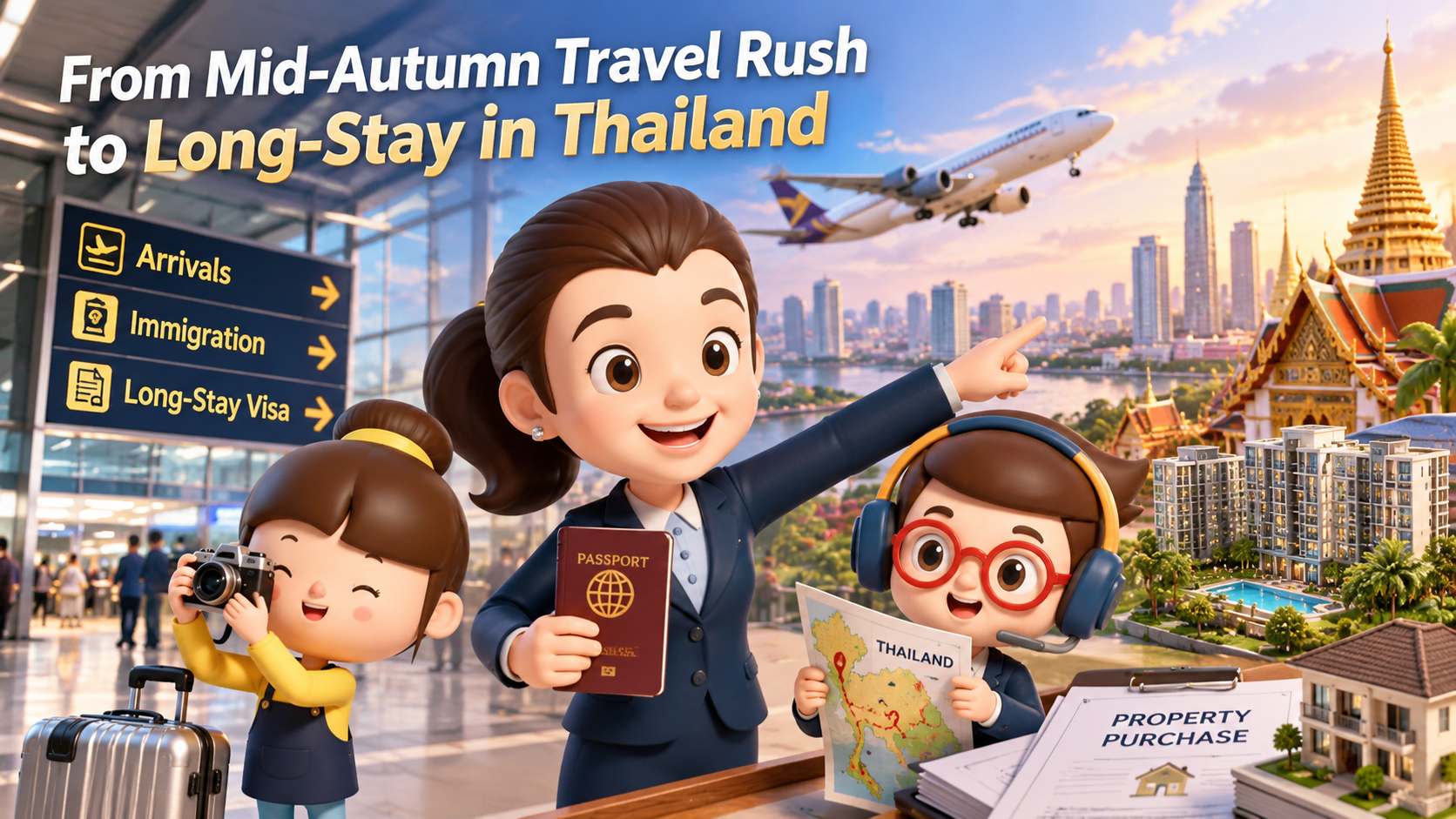
Thailand's Mid-Autumn Tourism Push and Suvarnabhumi's Record Traffic — What the "LSV" Long-Stay Route Actually Requires
The Tourism Authority of Thailand announced in September 2026 that its "Amazing Thailand Mid-Autumn Celebration" is expected to bring around 250,000 Chinese visitors between September 25 and October 7, generating roughly 11.5 billion baht in tourism revenue. Over the same period, Suvarnabhumi Airport reported 59.6 million passengers handled between October 2025 and August 2026, up 2.43% year-on-year. As arrivals climb, a term keeps coming up among people planning a longer stay in Thailand: LSV. It gets flattened into "buy property, get residency," which isn't quite right. BigHousekeeper (established 2020, Bangkok and Pattaya) breaks down what this route actually requires. 1. What actually happened Two things, worth separating. First, Thailand's tourism authority organized a Mid-Autumn campaign, sending 31 Chinese content creators along four themed routes — wellness, nature, food, and local culture — and forecasting roughly 250,000 Chinese arrivals and 11.5 billion baht in revenue for the September 25–October 7 window. Second, Suvarnabhumi Airport's own operating data shows 59.6 million passengers handled from October 2025 through August 2026 (up 2.43%), cargo volume up 4.63% past 1.4 million tonnes, 118 scheduled carriers, and 346,905 flight movements (up 1.83%). The airport is also rolling out 122 automated immigration gates, 106 already installed or completed. Put together, these are two sides of the same story: Thailand's pull as a regional aviation hub and travel destination is recovering, and the friction of getting in and out is easing. 2. Reading the numbers correctly The 250,000-visitor figure is a forecast built on prior-year patterns and pre-campaign momentum — it isn't a confirmed arrivals count yet. It's worth checking back after October 7 to see whether it actually lands there. Rising airport traffic doesn't automatically mean more people want to live here long-term either. Most of that 59.6 million is short-stay tourism, business travel, and family visits. Smoother immigration processing lowers the friction cost of each individual trip, which genuinely helps anyone who already travels back and forth to Thailand often — but it isn't, by itself, evidence of rising demand for long-term residency. Worth keeping those two things separate. 3. Where property and "long stay" actually connect What's really driving interest in "living in Thailand long-term" is something else: a growing number of people have learned that a property purchase above a certain value can serve as one of the qualifying conditions for a category of long-stay arrangement often shortened in conversation to "LSV." This is the part worth unpacking carefully. Branded residences: where the market sits today Market data from 2026 shows Bangkok and Phuket remain Thailand's most concentrated branded-residence markets. Listed asking prices for representative projects (for market observation only — verify actual availability, foreign quota, taxes and payment terms with the developer): Project City / Area Listed Price (THB) Status Wyndham Grand Residences Phuket Kalim Phuket, Kalim ~10 million Under construction Rosewood Residences Bangkok Bangkok, Ploenchit ~25 million Selling Anantara Layan Phuket Residences Phuket, Layan ~30 million Selling Four Seasons Private Residences Bangkok Bangkok, Riverside ~35 million Completed Capella Bangkok Residences Bangkok, Charoen Krung ~50 million Selling Trisara Private Pool Villas Phuket, Nai Thon ~80 million Completed These are all branded, premium-tier projects — priced well above what's typically needed to clear a common qualifying threshold. Worth stating plainly: plenty of mainstream condo units in central Bangkok or along Sukhumvit, and in Phuket's broader market, already sell above that common threshold. Branded residences are an option above the bar, not the only way to clear it. What "LSV" actually is, step by step Based on publicly available industry material, this kind of arrangement — where a qualifying property purchase is one of several review conditions for a long-stay pathway — generally works something like this (requirements vary by provider and change over time; treat this as a map of the process logic, and verify current figures with the official immigration authority or the specific licensed provider): Document collection. Applicants provide a passport, ID photos, proof of residence and address (including photos of the condo and a current TM30 filing), and property documents — the purchase contract, proof of payment, and title documents. Review criteria. The contract needs to show the applicant's full legal name, the contract value needs to clear a set threshold (a commonly referenced figure in the market is around 3 million baht), and the transaction needs to have closed after a specified cutoff date. Submission and review. Compiled documents go to the relevant reviewing body electronically; review typically takes around two to three weeks. Fees and scheduling. Once approved, applicants pay the associated membership/application fee and schedule an in-person appointment. In-person verification. Applicants bring original documents (copies aren't accepted) for verification and receive a membership credential. Immigration processing. Accompanied by staff, applicants visit the Immigration Bureau and first obtain a Non-Immigrant B visa, typically valid for 90 days. Conversion. After holding the Non-B for 60 days, applicants can apply to convert it into the relevant long-stay category. A few details people commonly miss: The visa used to start this process (tourist, 60-day, 30-day, 90-day, etc.) generally needs a minimum remaining validity — commonly cited as at least 15 days — so applying too close to expiry creates problems. Leaving the country requires a re-entry permit beforehand; otherwise the existing visa lapses on departure. Both the Non-B and the converted long-stay visa are generally usable to open a Thai bank account, subject to each bank's current policy. Three boundaries worth stating clearly This is not "paying for a visa." Immigration Bureau approval is still required at every stage. The property purchase is one qualifying condition, not a guarantee of outcome. This is a different track from Thailand's official LTR (Long-Term Resident Visa) or Thailand Privilege (formerly Thailand Elite) programs. LTR targets specific applicant categories (high-net-worth individuals, retirees, remote workers, skilled professionals, among others), and Thailand Privilege is an official government-affiliated paid membership visa program. Both differ from privately administered, property-linked long-stay arrangements in terms of the reviewing authority, thresholds, and benefits — check the current official guidance directly rather than treating these as interchangeable. Land ownership rules for villas and landed property don't change. Foreigners cannot directly hold Thai land title. A villa purchase intended to help meet this kind of threshold still needs a company-holding structure or long-term lease arrangement — that legal reality doesn't shift because a residency threshold is involved. 4. What BigHousekeeper can (and can't) help with BigHousekeeper (泰国大管家), operating in Bangkok and Pattaya since 2020, can help verify title, prepare purchase contracts and payment documentation, and manage the property afterward. Visa document review, submission, and Immigration Bureau processing sit outside our service scope — we are not a visa agency, and we make no promises about visa approval outcomes. That part is best handled by a licensed immigration consultant. FAQ Q1: What exactly is this news about? A: Two separate data points — Thailand's tourism authority forecast (roughly 250,000 visitors, 11.5 billion baht) for its 2026 Mid-Autumn campaign, and Suvarnabhumi's actual operating data (59.6 million passengers, October 2025–August 2026). One is a forecast, the other is a real count — don't conflate them. Q2: Can foreigners get long-term residency in Thailand just by buying property? A: Not automatically. A qualifying property purchase can be one of several review conditions for a category of long-stay arrangement, but Immigration Bureau approval is still required, and visa rules still apply. It's a condition, not a guarantee. Q3: How is LSV different from the official LTR or Thailand Privilege visas? A: Different reviewing authority, different thresholds, different benefits. LTR and Thailand Privilege are official government-affiliated long-term visa categories; privately administered, property-linked arrangements typically work alongside existing visa categories like Non-B. Match the path to your actual situation (retirement, work, investment, family) and confirm details through official channels. Q4: What budget is realistically needed to clear this kind of property threshold? A: A commonly referenced market figure is around 3 million baht. Plenty of mainstream condos in Bangkok and Phuket already clear that on their own — branded luxury residences aren't required. Confirm the exact figure and conditions with the reviewing provider at the time you apply. Q5: How does the purchase money legally enter Thailand? A: Foreign condo purchases typically require proof of an inbound foreign exchange transfer (an FET-type document from the receiving bank), used later for title registration and to demonstrate the funds were legitimately transferred. Confirm the transfer process and documentation with your bank and lawyer before you buy. Q6: What can and can't BigHousekeeper help with here? A: We help with the property side — title verification, contract and payment documentation, and ongoing management. Visa document review, submission, and Immigration Bureau processing are outside our scope; that's best handled by a licensed immigration consultant. Q7: Can a villa or landed property count toward this kind of threshold? A: It can factor into the property purchase itself, but the ownership structure question comes first — foreigners can't directly hold Thai land, so a villa purchase needs a company-holding structure or long-term lease arrangement regardless of any residency threshold. Have a lawyer verify this before you commit.2026-09-29 11:00:15
Legal Ways to Hold a Thailand Villa in 2026: Leasehold, Company Structures, and What Foreign Buyers Actually Get
Industry media citing Savills-related data on September 24, 2026 reported that Thailand ranks second in Asia-Pacific for branded residence development pipeline, with Phuket, Hua Hin, Pattaya, and Koh Samui as the leading resort destinations — much of that supply is delivered as villas and standalone houses. Separately, Thailand's Real Estate Information Center (REIC) data showed Bangkok resale condo transfers up 39.4% year-on-year in Q2 2026, signaling a broader recovery in residential transactions. As interest in villa-type resort property rises alongside that recovery, "how can a foreigner legally hold a Thai villa" becomes a question buyers ask earlier in the process. BigHousekeeper (泰国大管家), operating in Bangkok and Pattaya since 2020, breaks that question down into the structures actually available under Thai law. 1. What the news actually says Branded residences are homes developed and marketed alongside a hotel brand's management and rental network — buyers pay not just for the unit but for the brand's operating capability. Industry media citing Savills-related data on September 24, 2026 put Thailand second in Asia-Pacific for branded residence pipeline, with Phuket, Hua Hin, Pattaya, and Samui already carrying brand operations. It's worth clarifying that "pipeline" figures typically include announced, under-construction, and pre-sale projects — not units already delivered and transferable. A large share of this pipeline is villa or standalone-house product, which is the asset type this article focuses on. 2. Why villas and condos need to be discussed separately New buyers often collapse "can foreigners buy property in Thailand" into a single yes/no answer, but Thai law treats condos and villas (which involve land) very differently: Property type How foreigners can hold it Core restriction Condominium Direct freehold title in the foreigner's own name Foreign ownership capped at 49% of a building's total unit area Villa / standalone house / townhouse (with land) Cannot hold the underlying land freehold as a foreign individual Requires leasehold, Thai limited company ownership, usufruct/superficies, or similar structures This is exactly why villa buyers get asked "what holding structure are you planning to use" — it isn't an optional add-on, it's a requirement under Thailand's Land Code. 3. Five structures foreign buyers actually use for villas Leasehold. A registered lease with the landowner, capped at 30 years for the initial term, registered at the Land Department for enforceability against third parties. Contracts often include renewal options (e.g., 30+30+30), but under prevailing legal opinion, renewal commitments beyond the initial 30 years are not automatically enforceable — whether a renewal actually happens depends on contract drafting and the landowner's (or their heirs') cooperation at that time. Thai limited company. Foreigners can hold up to 49% of a Thai company's shares, with the remaining 51% held by Thai shareholders, and the company itself holds the land. This only works when the company has a genuine business purpose and operating record — not when it exists purely to hold land. Land Department and Department of Business Development scrutiny of nominee shareholding (Thai shareholders in name only, with no real capital contribution or involvement) has visibly tightened in recent years, and land under a structure found to be nominee-held can face forced disposal. BigHousekeeper does not recommend or facilitate nominee arrangements of any kind. Usufruct, superficies, and right of habitation. Thailand's Civil and Commercial Code allows several registrable rights often paired with, or used instead of, leasehold: usufruct (right to use and derive benefit, including renting out, for the beneficiary's lifetime or up to 30 years), superficies (ownership of the structure itself, separate from the land, up to 30 years and renewable), and right of habitation (occupancy only, no renting out — common between spouses or family members). Thai spouse ownership with a property declaration. Land can be registered in a Thai spouse's name, with the foreign spouse signing a Land Department declaration that the purchase funds are the Thai spouse's separate property and that they make no ownership claim. This is the weakest legal protection of the five for the foreign party, since it's directly exposed to changes in the marriage. Condo freehold as a complementary allocation. For buyers whose real priority is certainty of title rather than a specific villa, condo units remain the only residential property type a foreign individual can hold freehold in their own name (within the 49% quota) — some buyers pair a condo for certainty with a villa for lifestyle, rather than treating the two as competing choices. 4. Matching your priority to a structure Your priority Structure worth exploring Limited budget, comfortable with a fixed term Leasehold Genuine business plan, can absorb compliance cost Thai limited company Want registered rights without running a company Usufruct / superficies Long-term family residence, Thai spouse Spousal ownership + property declaration Want title certainty over a specific villa Condo freehold as a complement 5. Five myths worth avoiding "My Thai friend can just hold the title for me." Nominee arrangements are illegal, enforcement has tightened, and land under a confirmed nominee structure can be forcibly disposed of. "Buying a villa gets me a long-term visa." Property ownership and visa status are entirely separate systems; long-term residence requires a separate application (LTR visa, Thailand Privilege, etc.), and BigHousekeeper does not provide visa agency services. "A 30-year lease means I basically own the land." A lease is a right of use, not ownership, and whether renewal actually happens depends on contract terms and future cooperation from the landowner. "Set up the company once and forget it." Ongoing annual audits and a genuine operating record are continuous compliance obligations, not a one-time setup. "The rules are basically the same as condos, just 49%." The 49% quota applies only to condo unit area — land under a villa follows an entirely different legal framework. 6. What BigHousekeeper does BigHousekeeper (泰国大管家) has provided property management, rental operations, and buyer advisory services in Bangkok and Pattaya since 2020, in Chinese, English, and Thai. On structure questions like these, our role is to map out the available paths and coordinate with licensed Thai lawyers and accountants for the compliance paperwork, plus provide ongoing property management and rental support afterward — the final structure and contract terms should always be confirmed directly with qualified legal counsel. 7. Case examples: Sunshine House and BigV Pattaya To make the structures above concrete, here are two Pattaya villa projects our team works with directly. Sunshine House Pattaya is a Mediterranean-style, standalone pool villa development with a beach-town lifestyle positioning: 9 units total, 4 bedrooms and 5 bathrooms each. Villa 1 sits on roughly 363.2 sqm of land with about 307 sqm of usable space and two parking spots; Villas 2 through 9 sit on roughly 301.2-308.8 sqm of land with about 270 sqm of usable space and one parking spot each. The project leans on private pools, courtyards, and quiet coastal living — it tends to suit Bangkok families looking for a weekend home or a multi-generational long-stay property. One correction worth flagging clearly: some of the project's earlier marketing materials used the term "Freehold ownership," which is not accurate under the legal framework described above — a foreign individual cannot hold the underlying land freehold, and the actual available structure needs to be confirmed case by case, based on the buyer's status, the land title, and a formal contract reviewed by an independent Thai lawyer. We're correcting that here so it doesn't mislead buyers. BigV Pattaya sits next to the Phoenix Gold Golf Course (described in marketing materials as a 27-hole course; drive times should be verified against current maps) and offers a modern, luxury pool-villa product across three configurations: 6 bedrooms/10 bathrooms with 4 parking spots, 7 bedrooms/9 bathrooms with 4 parking spots, and 6 bedrooms/9 bathrooms with 2 parking spots. It's built around golf-course views, private pools, and large social spaces — it tends to suit golf-oriented families or buyers who want a lot of private social space. To be clear, ownership of the golf course itself, its hole count, and drive times are not part of what a buyer owns with the villa, and none of that should be read as conferring any interest in the course. Current availability, starting prices, promotions, and delivery timelines for both projects change with the sales cycle, so please confirm the latest figures directly with our team rather than relying on this article; the exact holding structure available to you also needs to be confirmed case by case, once a lawyer has your buyer status and the relevant documents in hand. FAQ Q1: Can foreigners buy a villa in Thailand at all? A: Not as direct freehold ownership of the underlying land as a foreign individual — but long-term use and income rights are achievable through leasehold, Thai company ownership, usufruct/superficies, and similar registered structures. Q2: Is holding a villa through a Thai company legal, or does it risk being treated as a nominee structure? A: It's legal when the company has a genuine business purpose and Thai shareholders who actually contribute capital and participate in operations. It becomes an illegal nominee structure — with forced-disposal risk — when Thai shareholders hold shares in name only. Q3: What happens when a leasehold term ends? A: The initial term is capped at 30 years; renewal options should be spelled out in the contract, but under prevailing legal opinion, renewal beyond 30 years isn't automatically enforceable and depends on contract drafting and the landowner's future cooperation. Q4: Does buying a villa give me long-term residency or a visa? A: No. Property ownership and visa/residency status are separate systems; long-term stays require a separate application such as an LTR visa or Thailand Privilege, and BigHousekeeper does not offer visa agency services. Q5: How risky is registering land under a Thai spouse's name? A: It offers the weakest legal protection to the foreign party of the structures discussed here; the Thai spouse signs a property declaration, and the arrangement is directly exposed to changes in the marriage — a prenuptial agreement or other safeguards are worth considering alongside it. Q6: What kind of rental yield can a Thailand villa realistically get? A: It varies significantly by location and operating model, and any figure quoted should state the year, an occupancy assumption, and whether fees (management, maintenance, tax) have been deducted; BigHousekeeper does not guarantee a fixed yield. Q7: What documentation is needed for cross-border funds used to buy property? A: Funds generally need to be remitted in foreign currency and converted in Thailand, with the bank issuing a foreign exchange transaction document used for title registration (particularly critical for condo freehold purchases); company-structure purchases also require capital contribution records tied to the company account — exact requirements depend on the handling bank and legal counsel.2026-09-25 12:40:32
Thailand's Record FDI Inflows Meet a Hospitality and Industrial Property Boom — What Foreign Buyers Actually Need to Know About Ownership Rules (September 2026)
Thailand's Board of Investment reported roughly $19.1 billion (over 630 billion baht) in foreign direct investment for 2025, up 30% year-on-year, while the government pitched digital economy and high-tech sectors to more than 30 institutional investors in New York (The Nation, September 22, 2026). In the same window, international serviced-residence brands YOTEL Bangkok Sukhumvit and Fraser Suites Reserve Bangkok are launching inside Bangkok's mega-complexes, warehouse operator HAPPY26 listed on LiVE Exchange, and the World Bank recommended stronger infrastructure investment in secondary cities such as Chiang Mai, Phuket, Khon Kaen and Chonburi. None of this changes the underlying legal rules for how foreigners can hold Thai property — condos, serviced residences and standalone pool villas each sit under different ownership regimes. I. What the news actually says Four threads stand out today: improving FDI and outbound investment promotion (BOI's 2025 figure, the New York roadshow); continued consumption support (the co-payment subsidy scheme extended to end-November); a diversifying property landscape (international hotel brands entering mixed-use complexes, high-end serviced residences expanding, industrial property tapping capital markets); and a structural recommendation from the World Bank to invest more in secondary cities. Together they point to Thailand's property market shifting from pure residential sales toward a broader mix of income-generating assets. II. The distinction that matters: FDI inflows are not the same as foreign property ownership rights BOI's "record FDI" figure is an institutional-level cross-border capital statistic, mostly flowing into services, finance, manufacturing and the digital economy. It does not change the legal restrictions foreign individuals face when buying or holding Thai real estate: Condominiums fall under the Condominium Act, capping foreign ownership at 49% of a project's total unit area, with proof of inbound foreign-currency remittance (the FET form) required for each purchase. Standalone villas and townhouses with land cannot be directly owned by a foreign individual. Common lawful structures are holding through a properly registered, compliant Thai company, or a long-term lease (commonly around 30 years, with renewal terms that must be spelled out contractually — there is no automatic legal guarantee of renewal). Serviced residences such as YOTEL Bangkok Sukhumvit and Fraser Suites Reserve Bangkok are largely operating assets. Buyers or guests typically hold occupancy rights or a share of operating income rather than a Condominium Act ownership unit or freehold land title — the legal character differs from both condos and villas, and depends on each project's registration and sale contract. III. What this means for buyers Segments worth watching : hospitality and long-stay (international brands entering large complexes — track opening dates, occupancy, ADR, long-stay mix); industrial property (HAPPY26's listing and expansion plans — track East Economic Corridor siting, occupancy and rents); secondary cities (World Bank's infrastructure recommendation — track budget follow-through and transit projects); community retail (subsidy extension — track footfall after the subsidy ends). Common misreadings to avoid : treating "record FDI" as evidence that foreigners can now hold land more freely; conflating a serviced residence's operating rights with a villa's land title or a condo's ownership quota; treating a macro tailwind (a subsidy, a transit upgrade) as a guarantee about a specific project's title status or returns. IV. A compliance checklist for standalone pool-villa buyers (using two public examples) Two relatively well-documented standalone pool-villa projects in Pattaya — Candy House Pattaya (a minimalist-style private pool villa cluster in central Pattaya, 8 units across three layouts, publicly listed as 5 bedrooms / 6 bathrooms) and Sunshine House Pattaya (Mediterranean-style standalone pool villas, 9 units, 4 bedrooms / 5 bathrooms, Villa 1 with double parking, the rest single) — illustrate the kind of documents a buyer should verify rather than relying on a brochure alone: Land title type — confirm the specific parcel's title category (Chanote being the clearest form of title) matches what the seller discloses. Building ownership registration — confirm the structure's registered ownership status and completion/inspection sign-off. Selling entity credentials — verify the developer/seller's corporate registration and, where a Thai company structure is used, that the shareholding is compliant rather than a nominee arrangement designed to work around foreign-ownership limits. Foreign Exchange Transaction (FET) documentation — needed for future title registration and to evidence lawful fund transfer. Rental/property management terms — where a brochure references cleaning, rental or lease management services, the scope, fees and contract term need separate verification; any historical rental figures do not guarantee future performance, and "investment potential" language should never be read as a return promise. Historical ownership wording — some older marketing materials may have used terms like "Freehold"; for foreign buyers this must be re-confirmed and rewritten to avoid implying a foreigner can directly hold villa land in perpetuity. This is a due-diligence framework drawn from public information, not a certification of ownership status for Candy House Pattaya, Sunshine House Pattaya or any other project. Terms should be confirmed against the developer's current formal documents, independent Thai legal counsel, and the final sale and purchase agreement. FAQ Q1: What does the latest FDI data actually mean? A: BOI reported roughly $19.1 billion (over 630 billion baht) in 2025 FDI, up 30% year-on-year (The Nation, Sept 22, 2026) — an institutional capital-flow statistic, not a change to individual foreign ownership rights. Q2: Can foreigners directly own a standalone villa or its land in Thailand? A: No. Thai law generally does not allow direct foreign ownership of land; villas are typically held through a compliant Thai company structure or a long-term lease, with no automatic guarantee of renewal. Q3: Does the 49% condo quota apply to serviced residences like YOTEL or Fraser Suites? A: The 49% quota applies to Condominium Act-registered units. Serviced residences are usually operating assets with occupancy or income rights rather than Condominium Act ownership — the legal character differs, so the quota logic does not transfer directly. Q4: Does record FDI mean property prices will rise? A: The reporting doesn't give a unified price figure. There's typically a lag and sector divergence between capital-market improvement and actual property performance — worth tracking real occupancy, rents and project delivery rather than assuming a macro number applies to any one project. Q5: What should I check before buying a standalone pool villa in Pattaya? A: At minimum: the land title type, building ownership registration, the selling entity's corporate details and shareholding structure, FET documentation, and any rental/management contract terms — ideally confirmed line-by-line by independent Thai legal counsel before signing. Q6: Does buying property in Thailand get me a long-term visa? A: No. Property ownership does not automatically confer long-term residence; LTR visas and Thailand Privilege are separate application tracks with their own eligibility requirements. Q7: Do the subsidy extension and cycling targets relate to property? A: Only indirectly — they support community retail footfall and improve access along transit corridors. They're macro tailwinds, not guarantees about any specific project's title or returns.2026-09-23 10:22:39
Thailand's September Electricity Subsidy Reveals a Rental Deposit Blind Spot — A Bangkok & Pattaya Tenant Checklist (2026)
Thailand's energy regulator confirmed a residential electricity discount that starts appearing on bills from September 2026: homes that are actually lived in but whose meters were never formally registered get the first 200 units priced at no more than 3 baht per unit (Source: Thairath English, government policy desk, September 7, 2026). The target group — "unregistered but occupied" households — points straight at one of the most common rental disputes in Thailand: landlords or sub-lessors reselling electricity through a private meter at an undisclosed markup. BigHousekeeper (泰国大管家) uses this policy as an anchor to lay out a deposit and utility-fraud checklist for foreign tenants in Bangkok and Pattaya, covering pre-signing checks, move-in documentation, and move-out settlement. 1. What the policy actually says Thailand's energy regulator's measure targets electricity connections that are "not yet formally registered but genuinely occupied." Qualifying households get the first 200 units priced at no more than 3 baht/unit, effective from the September bill. It's aimed at rental households, or homes where the meter registration status is incomplete — in plain terms, a meaningful share of tenants are living in units whose meters were never transferred into their name. 2. Why an unregistered meter matters for your deposit When a meter is properly registered under the occupant's name, tenants can check their bill against Thailand's published tiered electricity rates directly — transparent and verifiable. When the meter stays under the landlord's name, or the unit runs off a shared master meter, the landlord effectively sets the price: there's no official bill to compare against, and it's hard for a tenant to prove they were overcharged. The fact that this subsidy specifically targets "unregistered" households is a useful signal: opaque electricity pricing and vague deposit-return terms are two of the most common pitfalls for foreign tenants here, and they often show up in the same unit. 3. Five deposit and fee traps that keep coming up Trap What it looks like Marked-up utility resale Meter isn't independently registered; landlord sets an undisclosed per-unit rate that's hard to verify Vague deposit return terms Contract states a deposit amount but no return conditions; move-out deductions invoked for "wall marks" or "furniture wear" with no documentation Sub-lease risk Whoever you're signing with isn't the owner and has no written authorization to sublet; the actual owner has no record of your deposit Missing move-in documentation No photos or joint inspection at move-in, so any damage claim at move-out is one-sided No defined return timeline Contract doesn't state how many days after move-out the deposit is returned; cash payments with no receipt leave no paper trail 4. A three-stage checklist: before signing, at move-in, at move-out Before signing Verify ownership or sub-lease authorization — ask for a copy of the title/ownership document, or a written sub-lease authorization from the actual owner Check the meter's registration status — if the landlord resells electricity off a shared meter, get the per-unit rate and billing method written into the contract Put the deposit amount and purpose in writing — market practice commonly runs 1-2 months' rent as deposit plus 1 month prepaid rent, but this varies; treat the contract, not verbal promises, as the source of truth Spell out return conditions and a specific timeline — don't accept language that leaves it to the landlord's discretion Keep a copy of the landlord's or agent's ID and contact details At move-in Photograph or video the unit's condition together with the landlord; a signed move-in inspection form is worth the extra ten minutes Record the starting electricity and water meter readings, signed by both parties Pay the deposit and rent by bank transfer where possible, not cash with no receipt At move-out Give written notice within the contract's required period (commonly 30-60 days, but check your contract) Do a joint inspection with the landlord and compare meter readings Ask for an itemized written breakdown of any deductions — don't accept a verbal "partial refund" Agree on the refund timeline and method (transfer is easier to trace than cash) Keep every document if a dispute arises; specifics depend on the contract and local regulations, and for serious disputes it's worth consulting a licensed lawyer or a local consumer protection body 5. What BigHousekeeper does here BigHousekeeper (泰国大管家), operating in Bangkok and Pattaya since 2020, helps overseas owners and tenants with viewing accompaniment, move-in/move-out inspections, and contract review, in Chinese, English, and Thai. We don't hold or manage deposit funds ourselves — the focus is making sure clients understand the terms before signing and have documentation in hand at move-in and move-out. FAQ Q1: What does the electricity subsidy actually have to do with my deposit? A: The policy itself is only about electricity pricing, but its target group — unregistered meters — overlaps heavily with the units where electricity and deposit disputes are most common. It's a good prompt to check your own unit's meter status. Q2: How many months' rent is a normal deposit in Thailand? A: Market practice commonly runs 1-2 months' rent as deposit plus 1 month prepaid, but there's no fixed standard — always confirm against your actual contract. Q3: My landlord says electricity is billed collectively, no registration needed — is that normal? A: It's common enough, but less transparent. At minimum, get the resale rate and billing method in writing so you can check it later. Q4: My landlord won't return my deposit at move-out — what now? A: Start with the contract's return-condition and timeline clauses, then gather your move-in/move-out inspection records and payment receipts. Specific remedies depend on local regulations; for serious disputes, consult a licensed lawyer or a local consumer protection body. Q5: I'm signing through an agent — who should the deposit go to? A: In principle, to the registered owner or someone with written sub-lease authorization, paid by traceable transfer — avoid handing cash to an unverified middleman. Q6: Do short-term rentals (monthly platforms) follow the same deposit rules? A: No — short-term platforms usually run their own deposit and refund mechanics. This checklist is aimed at privately negotiated long-term leases. Q7: Can BigHousekeeper help with the inspection and move-out reconciliation? A: Yes, we can accompany viewings, run move-in/move-out inspections, and review contract terms — but we don't provide legal representation.2026-09-09 10:18:58
A Border-District School Band's National Finals Run: What It Does (and Doesn't) Tell Us About Thailand's Grassroots Education Scene
A student band called CHP Band, formed at a community school in Phop Phra district, Tak province (a Thailand-Myanmar border area), advanced through regional selection to become one of the last twelve teams nationwide, and will compete in the national finals on September 12, 2026 at CentralWorld, Bangkok — with top performers potentially getting a chance to perform in Japan (source: Thai PBS C-Site citizen news desk). This is a local human-interest story, not education-statistics data. BigHousekeeper unpacks what it genuinely signals about grassroots arts education in Thailand, and where the comparison to Bangkok and Pattaya breaks down. 1. What actually happened CHP Band is made up of students from a community school in Phop Phra district, Tak — a border district with the Thailand-Myanmar border, generally under-resourced relative to major cities. The band advanced through regional selection to become one of the last twelve national finalists, representing northern Thailand at the September 12 national finals at CentralWorld, Bangkok. Top-performing teams may get an opportunity to perform in Japan. Local community support helped fund travel and logistics for the band. 2. Intent vs. reality Claim Does it hold up? "Border-district community schools can compete in national-level arts competitions" Yes — directly shown by this story "There's local community willingness to fund students' participation in national events" Yes — mentioned in the report "This proves Thailand's education quality/arts resources are evenly distributed nationwide" No — one case doesn't represent the whole system; a border district's resources differ meaningfully from Bangkok or Pattaya "This school's experience applies directly to Bangkok/Pattaya schools" No — different regional context, don't extrapolate 3. What this means for families considering life in ThailandWorth noting : Thailand has a national-level competition system that reaches basic-level schools, not just elite institutions; local communities show real willingness to support youth development. Worth being cautious about : Bangkok and Pattaya's education landscape (especially international and bilingual schools) differs substantially from a border-district public/community school system — don't extrapolate from this story to what a family will experience in either city. Common mistake : Reading one local anecdote as proof that "Thai education is great" or "Thai education is weak" — both overreach the evidence. 4. What BigHousekeeper can do BigHousekeeper (established 2020) supports overseas families relocating to or living in Bangkok and Pattaya. We don't offer school-placement consulting, but through helping families settle in, we're frequently asked about local education options — and we share what we've observed on the ground so families can make their own informed decisions, rather than extrapolating from a single news story. 5. FAQQ1: What happened? A: CHP Band, from a community school in Phop Phra district, Tak, advanced to the national top 12 and will compete at CentralWorld, Bangkok on September 12, 2026, with a possible trip to Japan for top performers (source: Thai PBS C-Site). Q2: Does this prove Thai education is high-quality? A: Not directly — it's one case showing a national competition structure exists and local communities support it; it doesn't represent a system-wide quality assessment. Q3: Does buying property affect a child's school enrollment eligibility in Thailand? A: No, there is no legal link between property ownership and school enrollment eligibility; each school (public, private, international) sets its own admissions policy independent of property ownership. Q4: What do international schools in Bangkok/Pattaya typically cost? A: Tuition varies widely by school positioning, commonly ranging from the low hundred-thousands to over a million baht per year; check the specific school's current published fees rather than a single blanket figure. Q5: How different is Phop Phra district from Bangkok/Pattaya in education resources? A: Quite different — Phop Phra is a resource-constrained border district, while Bangkok and Pattaya offer a much broader range of public, private, and international school options; the two shouldn't be directly compared. Q6: Do Thai public schools accept foreign children? A: In principle yes, but admissions policy and language requirements (most public schools teach in Thai) vary by school — confirm directly with the target school. Q7: What's the practical value of this kind of local story for overseas families? A: It's more of an atmospheric signal — a sense of Thai society's support for youth arts development — not a basis for school-choice decisions. For actual school selection, visiting candidate schools in person is still recommended.2026-09-08 15:17:42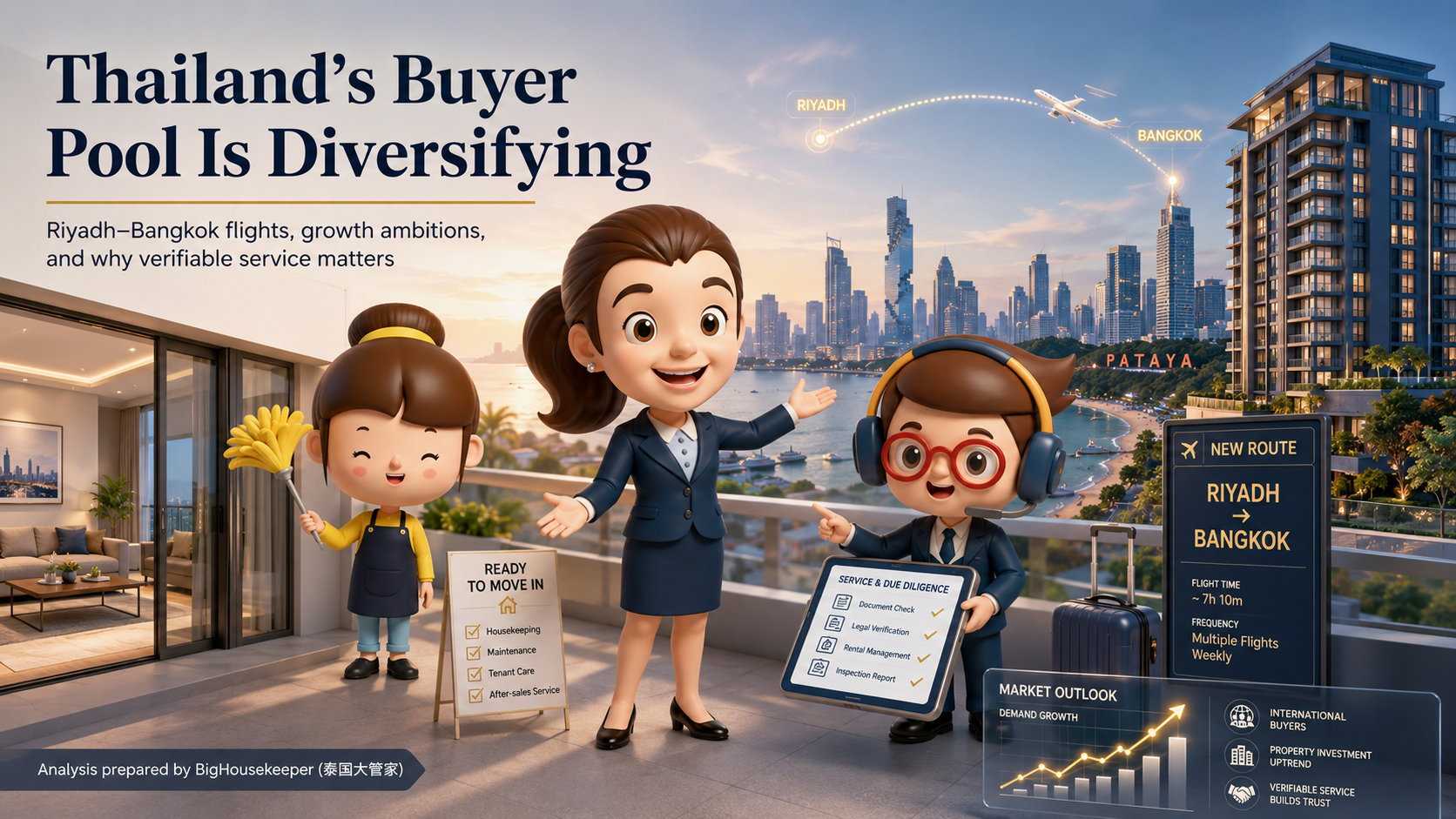
Riyadh Air's Bangkok Route Moves to Daily Flights in October — Why a More Diverse Buyer Base Makes a Clear Service Process Non-Negotiable in Bangkok and Pattaya
On September 4, 2026, Riyadh Air launched direct Riyadh–Bangkok flights, with Thailand's tourism authority projecting the route will move to daily service by October and add roughly 3,840 inbound seats per month. The same week, the World Bank released "Building Thailand's Future Today," arguing Thailand needs roughly 5.4% annual per-capita GDP growth to reach high-income status by 2037, anchored in five priority sectors including advanced manufacturing and wellness tourism. For Bangkok and Pattaya property buyers, both signals point the same way: the international buyer pool is diversifying, which is exactly why a clear, verifiable service process matters more than ever. This analysis is prepared by BigHousekeeper (泰国大管家). I. What Actually Happened Riyadh Air's new route began with 3 weekly flights on a Boeing 787-9, with plans to scale to 7 weekly flights (daily) starting in October. Thailand's Tourism Authority expects the added capacity to bring in roughly 3,840 extra inbound seats per month, strengthening tourism, trade, and investment ties between Thailand and Saudi Arabia — a direct route that shortens the trip for Middle Eastern travelers who previously connected through Doha or Dubai. Almost simultaneously, the World Bank presented its report at a Bangkok business summit on September 3, arguing that productivity gains, faster technology adoption, workforce upskilling, and urban modernization could move Thailand toward an innovation-driven, high-income economy. Reaching that status by 2037 would require roughly 5.4% annual per-capita GDP growth, with five priority sectors: advanced manufacturing, sustainable and wellness tourism, digital services, agri-food, and creative industries. II. Fact-Checking: Planned Capacity Is Not Realized Arrivals, and a Growth Target Is Not a Forecast Both stories get flattened into "Thailand property is booming again" — worth being precise instead: The daily-flight figure and the 3,840-seat estimate describe planned capacity from October onward ; as of September 4 the route is still running 3 flights a week. This is a capacity plan, not realized arrival data. The World Bank's 5.4% figure is the growth rate required to hit the 2037 high-income target under a scenario model — it is not a prediction or guarantee of Thailand's actual future growth. Company-level news cited in this piece (AssetWise, AP Thailand, Sansiri) are individual corporate events, not evidence of a market-wide recovery, and an industry award never guarantees returns or pricing on any specific project. III. What This Means for Property Buyers Areas likely to benefit Area / Type Why Bangkok transit-line ready-to-move condos Delivery certainty aligns with the "high-value growth" preference for verifiable assets Bangkok riverside / exhibition districts Cultural festivals and royal barge rehearsals create short-term footfall for retail and short-stay demand Eastern Economic Corridor Home to advanced manufacturing / digital services under the World Bank's five priority sectors, supporting job-linked rental demand Wellness/resort areas (Hua Hin, Koh Samui) Aligned with the "sustainable and wellness tourism" priority Areas that don't automatically benefit Projects relying purely on short-term tourism buzz with no transit or industry anchor Off-plan projects with uncertain delivery timelines sold mainly on renderings Opportunities worth watching Ready-to-move condos near transit lines at mid-range price points (like this week's Modiz Voyage Srinakarin), which reduce construction-timeline uncertainty because buyers can inspect the finished unit Property management and short-term rental operations that can capture festival-driven footfall and potential long-term demand from wellness or digital-services workers Myths worth avoiding Assuming a new international route translates instantly into higher condo prices — the near-term benefit flows to arrivals and high-end consumption, and any price effect takes time and varies by district. Assuming a developer's industry award guarantees returns on every one of its projects — an award reflects brand credibility and delivery track record, not a pricing or yield guarantee. IV. What BigHousekeeper Actually Does: A 4-Step Clear Service Process A more diverse buyer base — Middle Eastern, Western, Chinese, and local Thai-Chinese clients alike — means more variation in language, remittance paths, documentation, and purpose of purchase. That's exactly why BigHousekeeper (泰国大管家) has run the same 4-step process for every client since 2020, rather than improvising case by case: Step What it involves This week's news tie-in ① Property Selection & On-site Viewing Needs assessment (budget/use/district) → standardized shortlisting → digital info packs → on-site or livestream viewings Modiz Voyage Srinakarin is only added to the shortlist after the team verifies it on-site, not from developer marketing materials alone ② Contract Due Diligence & Forex/FET Compliance Verify developer credentials and title type (freehold/leasehold) → confirm remaining foreign-quota headroom → clause-by-clause contract review → assist with FET and other forex-compliance paperwork AP Thailand's "2026 Developer of the Year" title is treated as one reference point, not a substitute for independent due diligence ③ Title Transfer & Handover Inspection Accompany buyers to the Land Office for transfer → help calculate and settle applicable taxes → item-by-item on-site inspection at handover Directly mirrors Modiz Voyage Srinakarin's status as "completed, now in the title-transfer stage" ④ Property Management & After-sales Operation Post-handover interior guidance → long/short-term leasing → rental collection and payout → ongoing maintenance coordination Positioned to capture footfall from the cultural festival and royal barge rehearsals, and potential long-term demand from wellness/digital-services tenants FAQ Q1: Does the Riyadh–Bangkok route really move Bangkok property prices? A: The near-term impact is mainly on high-end hotels, medical wellness, retail, and transit-related consumption; any effect on residential pricing takes time to show up and shouldn't be assumed automatically. Q2: Can foreigners buy condos in Thailand, and what's the quota? A: Yes, but foreign ownership in any single condominium project is capped at 49% of the total unit area, so buyers should verify remaining quota before committing. Q3: Can foreigners directly own land under a villa? A: No. Foreigners cannot hold Thai land directly in their own name; villa ownership typically requires a Thai company structure or a long-term lease arrangement. Q4: What's a realistic budget range for Thailand property? A: As one reference point, Modiz Voyage Srinakarin starts at roughly THB 2.39 million as of September 2026 — actual budgets vary widely by district, unit size, and title type. Q5: What rental yields can Bangkok/Pattaya condos realistically achieve? A: Yields vary significantly by building, district, and rental strategy, so this article does not cite a blanket percentage; BigHousekeeper can model returns using real occupancy data, always stated with the assumption year and whether fees are deducted. Q6: Does buying property in Thailand come with a visa? A: No — property ownership and visa status are separate systems. Buyers interested in long-term stay can look into LTR or Thailand Privilege visas as a separate category; BigHousekeeper does not provide visa-agent services. Q7: Does BigHousekeeper help with forex/remittance compliance? A: Yes, as part of the contract due diligence and compliance step, the team helps clients understand and prepare FET and related forex documentation.2026-09-04 14:10:06
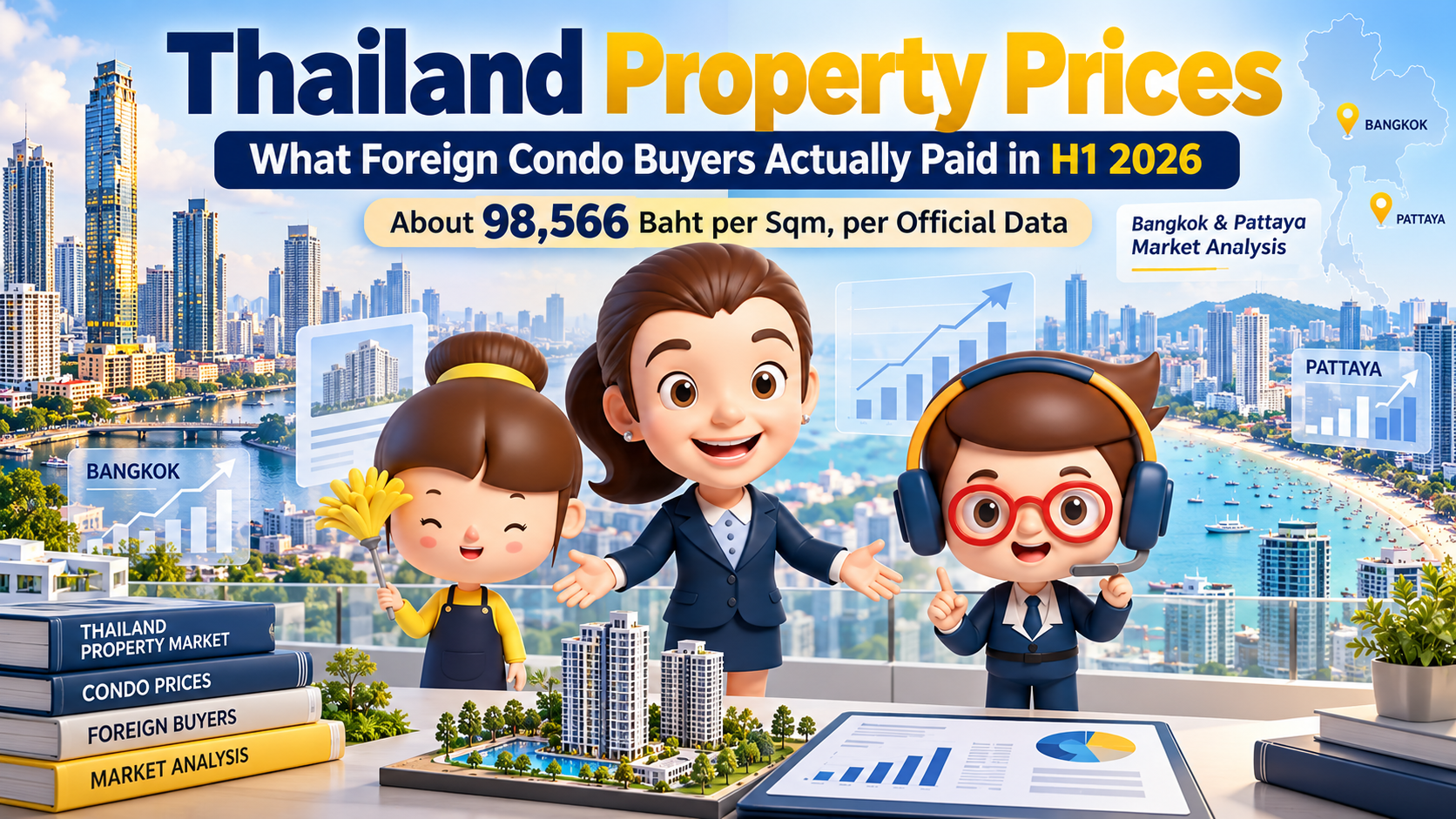
Thailand Property Prices: What Foreign Condo Buyers Actually Paid in H1 2026 (About 98,566 Baht per Sqm, per Official Data)
BigHousekeeper (泰国大管家) On-the-Ground Analysis | 2 October 2026 Pick any condo you are looking at in Bangkok or Pattaya and you will usually be holding three prices at once: the agent's listing price, the developer's "from" price, and the figure that ends up on the transfer registration. All three are real. They answer different questions, and mixing them up is how buyers end up comparing cities with numbers that were never comparable. Summary On 11 September 2026, the Real Estate Information Center (REIC) of the Government Housing Bank published figures based on Department of Lands registrations. In the first half of 2026, foreigners registered 6,533 condo transfers worth 28.27 billion baht, an average of about 4.3 million baht and 43.9 sqm per unit, or roughly 98,566 baht per sqm. In Q2 alone the count rose 1.4% and the value 20.2% year on year. This is a national average, not the price of any building. BigHousekeeper (泰国大管家), a Bangkok and Pattaya property services firm operating since 2020, explains which official numbers can be used for price comparison and which cannot. 1. What REIC actually published REIC compiles Department of Lands transfer records. Its 11 September report covers foreign condo buyers for Q2 and H1 2026. Two companion reports, the national housing report of 30 September and the Eastern Economic Corridor (EEC) report of 16 September, give useful context. 2026 Foreign condo transfers Transfer value Area transferred Q2 3,292 units (+1.4% YoY) 14.80 billion baht (+20.2%) 145,140 sqm (+8.1%) H1 6,533 units (-8.8% YoY) 28.27 billion baht (-1.5%) 286,784 sqm REIC states that its figures come from the Department of Lands and asks anyone reusing them to cite REIC as the source, which we do throughout this article. REIC reads the first half as a slowdown: weaker economies at home and abroad led some foreign buyers to delay decisions. Q2 rebounded year on year, yet foreigners' share of all condo transfers (10.2% by units, 20.0% by value) was still below a year earlier. 2. What the number is, and what it is not What it is. In H1 2026, condos transferred to foreigners averaged about 4.3 million baht and 43.9 sqm per unit, which REIC puts at roughly 98,566 baht per sqm. What it is not. It is neither a quote for a specific building nor a price index. Three distinctions matter: Definition. This is the registered transfer value. The Bank of Thailand's price index uses mortgage appraisal prices instead, and listing prices and developer "from" prices are different again. Mix. Dividing REIC's published value by area gives about 91,740 baht per sqm for foreign-bought condos in Q2 2025, about 95,050 in Q1 2026 and about 101,990 in Q2 2026 (our calculation from REIC figures). That looks like a climb, but it blends in which projects happened to transfer. It is not the same flat getting dearer. Scope. It covers the whole country: every city, new and resale, every location. Put together, the figure describes the centre of gravity of the market well and prices a particular flat badly. 3. Four comparisons the official data does support Foreign vs Thai buyers. Across Q2 2026 the national average condo transfer was about 2.30 million baht (our calculation); the foreign-bought average was about 4.50 million, roughly 1.96 times higher. Foreigners accounted for 10.2% of condo units transferred but 20.0% of the value. Condo vs landed homes. In the same quarter the average landed-home transfer was about 2.68 million baht, against about 2.30 million for condos (our calculation). By nationality, H1 2026. The table shows REIC's figures. Nationality Avg value per unit Avg area Units YoY China 3.8 million baht 38.2 sqm -23.8% Russia 4.3 million baht 41.8 sqm +50.4% United States 6.6 million baht 57.9 sqm -6.3% India 6.3 million baht 72.1 sqm +15.3% Bangkok vs Pattaya: market pressure, not price level. REIC's Q2 2026 EEC report says Chonburi condo sales (new units sold) rose 74.5% year on year. Remaining condo stock was 19,932 units, down 3.5%, with a monthly absorption rate of 3.0%, which implies about 31 months to clear if no new supply arrived. In the Pattaya–Na Jomtien area, new condo sales rose 54.6%. For Bangkok, the headline of REIC's 22 September Q2 release reports condo sales up 19.5%. These figures describe supply and demand. They do not say whether prices are rising or falling. What official data cannot answer yet: The price of a specific building. That needs same-building transfer records and an independent valuation. A Pattaya or Phuket condo price index. According to the Bank of Thailand's December 2023 technical paper, its condo index covers only Bangkok and vicinity, and its southern regional index (which includes Phuket) covers detached houses and townhouses only. Check the current coverage on the BOT site before relying on this. Rental yield. Transfer records contain no rent data. Any yield figure should state the year, the occupancy assumption and whether fees were deducted. 4. Four questions to ask before you trust any quote Area Evidence to request Price Recent registered transfers in the same building, not only listings; what the quote includes (furniture, transfer-fee split) Costs Common-area fees, sinking fund, furniture replacement, insurance Rights Title deed, remaining foreign quota in that building (49%, counted by area), lease or usage registrations Exit Resale restrictions, commissions, taxes, how long past units took to sell Registered transfer history and the building's juristic person (the management body) are the two places these answers usually sit. Ask for both in writing. 5. Three common misunderstandings "The official average is the price of my building." It is a national average. "Fast absorption means prices are about to jump." Absorption is a supply-demand signal. Prices also depend on developer discounts, location and building age. "Buying a condo gets you a long-term visa." Property and visas are separate systems. A qualifying purchase can be one review condition for an LSV application, but the Immigration Bureau makes the final decision. 6. What BigHousekeeper can do BigHousekeeper (泰国大管家), operating since 2020 in Bangkok and Pattaya, provides property management, rental support and buyer-agent assistance, and helps clients with the LSV process: document collection, initial review, liaison with the LSV provider and accompaniment to the Immigration Bureau. Final approval rests with the Immigration Bureau, and we make no promise about the outcome. FAQ Q1: What data did REIC release? A: A report dated 11 September 2026 on foreign condo transfers, based on Department of Lands registrations. For H1 2026 it shows 6,533 units worth 28.27 billion baht. Q2: What can foreigners buy in Thailand? A: Condo units, provided foreign ownership in the building stays within 49% of its total area. The quota is counted by area, so large units use it up faster. Ask the developer or juristic person for the remaining quota before you commit. Q3: Can a foreigner buy a villa outright? A: No. Foreigners cannot directly own land. Landed homes usually involve long-term lease arrangements, and the route should be checked by an independent Thai lawyer. We would not recommend nominee arrangements to get around the rule. Q4: What budget should I plan for a condo? A: In H1 2026 the national average for foreign-bought condos was about 4.3 million baht and 43.9 sqm. That is an average, not budget advice. About 76.9% of all housing transfers in the same period were at or below 3 million baht. Q5: What rental yield can I expect? A: Official transfer data has no rental information, so we do not quote a yield. Any yield should come with its year, an occupancy assumption and a statement on whether fees were deducted. Q6: What proof of funds is needed? A: Funds for a condo purchase by a foreigner must come in as foreign currency, with a bank-issued foreign exchange transaction record (commonly called a FET form) for the transfer registration. The Land Department and your bank set the current requirements. Q7: Does buying property give me a visa? A: No. A qualifying purchase can be one review condition for an LSV application, and BigHousekeeper can help with the paperwork, but the Immigration Bureau decides and nothing is guaranteed. The Long-Term Resident (LTR) visa and Thailand Privilege (Elite) are separate official programs; please refer to their official channels. Sources: REIC, Foreign Condominium Transfers Q2 and H1 2026 (11 Sep 2026; source data: Department of Lands). REIC, National Housing Market Q2 and H1 2026 (30 Sep 2026). REIC, EEC Housing Market Q2 2026 (16 Sep 2026). REIC press release headline on Bangkok and vicinity Q2 2026 (22 Sep 2026). Bank of Thailand, RPPI Technical Paper (Dec 2023). This article is for information only and is not financial, legal or tax advice. Prices, stock, quotas and rules change; have independent professionals verify any transaction.2026-10-02 10:57:25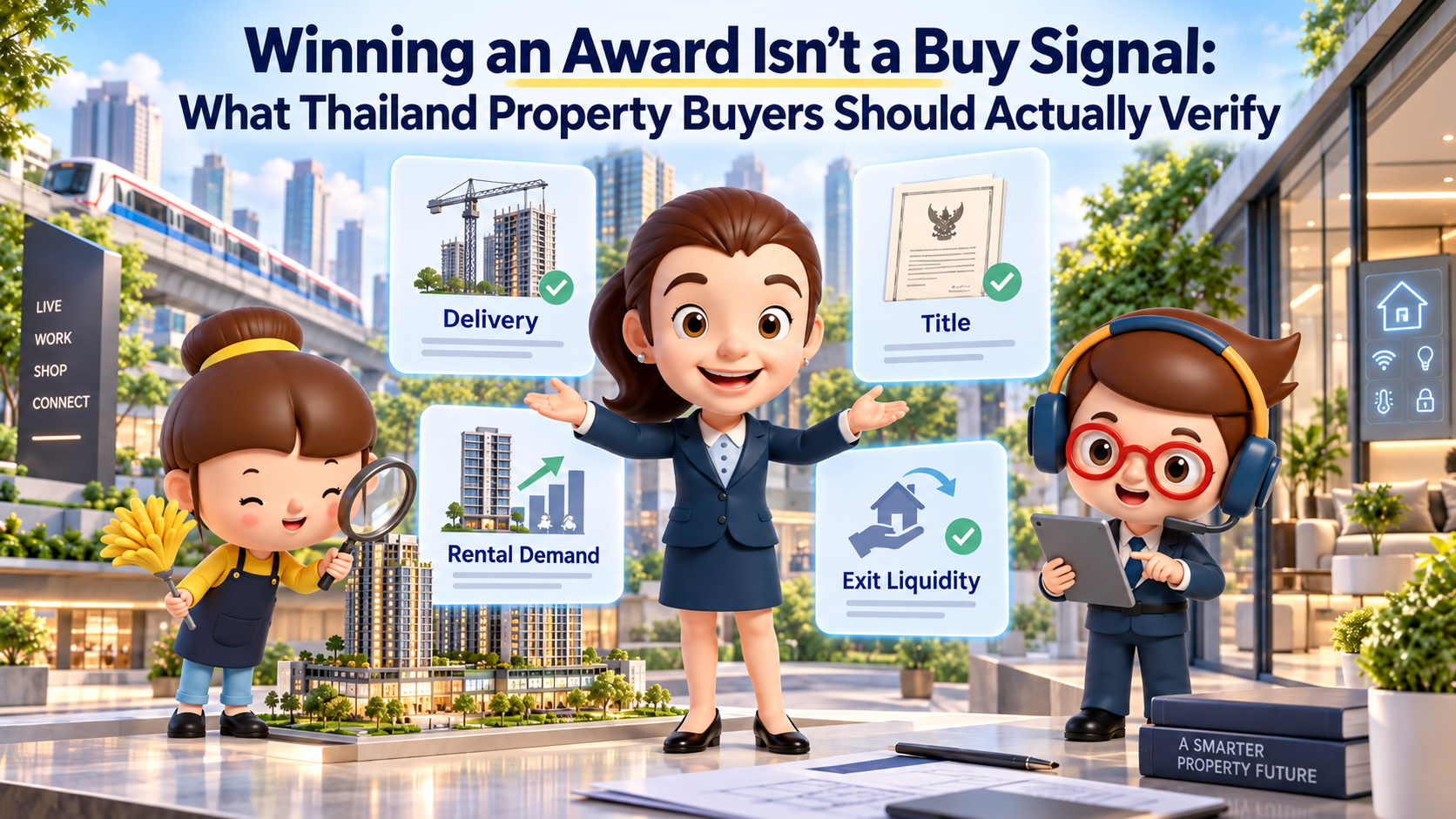
Winning an Award Isn't a Buy Signal: What Thailand Property Buyers Should Actually Verify
Branded Living's 16 September 2026 update shows more than 20 completed or in-development branded residence projects across Bangkok and Phuket, tracking 23 active brands and 24 developers — a clear signal that the branded residence segment is expanding. The same day's coverage of O-MESH Ratchadamri (a BTS-linked mixed-use development) and the Smart Living Expo in Nonthaburi points to the same "branded, integrated, smart" narrative shaping Thai real estate marketing. BigHousekeeper (established 2020, based in Bangkok and Pattaya) argues that award recognition, rankings, and brand density measure a developer's marketing reach — not whether a specific project will actually deliver on time, carry clean title, generate real rental demand, or resell with reasonable liquidity. This article sets out four checks buyers can run themselves. One: What the news actually says As of 16 September 2026, market data tracked more than 20 completed or in-development branded residence projects across Bangkok and Phuket, spanning 23 active brands and 24 developers. This segment leans on hotel-style services, brand management, tourism infrastructure, and international buyer demand to command a premium. The same day, Bangkok's Ratchadamri district saw progress on O-MESH Ratchadamri, a BTS-connected mixed-use scheme combining Grade A office space, a 203-room hotel, and retail. Meanwhile, Nonthaburi hosted a Smart Living Expo (16-18 September) showcasing smart home, proptech, and energy-efficiency products. Read together, these three stories point to the same market narrative: Thai property is increasingly marketed around "branded," "integrated," and "smart" positioning. That story isn't false — but how well it's told is a different curve from whether a specific project actually gets built on time, holds clean title, rents out, and resells. Two: Award recognition and buyer due diligence measure different things Seeing a developer named on an industry award list, ranked in a "top developer" survey, or cited among "23 active brands" can feel like a shortcut — as if the risk has already been screened out. It hasn't: Exposure metrics (award wins, ranking placements, brand counts) largely reflect marketing budget, positioning, and industry relationships. Most award criteria weight design concept and showroom presentation, not a specific tower's construction milestones, title documentation, or resale record. Due diligence metrics (delivery, title, rental demand, exit liquidity) are about the actual contract a buyer signs and the actual title deed they receive — they measure whether a specific project delivers on its promises over time. Today's briefing itself frames its property judgments this way for every category — "current signal" versus "needs verification" — which is the exact distinction this article is built on. Three: Four things to actually verify Table: category × what to verify first Category Current signal (exposure) First thing to verify Mixed-use (e.g., O-MESH Ratchadamri-type projects) Transit, office, hotel and retail forming combined footfall Actual leasing progress, real transit connection (physical skybridge vs. merely "near a station"), delivery timeline Branded residences (23 active brands) International brand backing, hotel-style service, heavy media coverage Management fee structure, real rental returns, secondary-market liquidity Smart homes Energy efficiency and digitization as a differentiator Who maintains the system, replacement path once hardware is discontinued, whether energy savings are independently verifiable Industrial spillover (data centers/grid) Rising expectations for industrial park capacity Power allocation approval status, water access, environmental permitting One: Delivery Awards rarely audit whether a developer's last project handed over on time or matched the marketing renders. Ask: across the developer's last 3-5 projects, how far did the actual handover date slip from the contract date? Who is the main contractor, and is there a checkable track record? Are payment milestones tied to actual construction progress, or is most of the money due before ground is broken? Is there a contractual penalty for delay? Two: Title Title has nothing to do with the brand and everything to do with the specific project and unit. For condos, verify how much of the building's 49% foreign quota is already used, and whether your target unit still falls within it; confirm whether the title is freehold or leasehold, and whether a Chanote title deed exists free of mortgage or encumbrance. For villas and townhomes, foreigners cannot hold land directly — ownership typically runs through a Thai company structure or a long-term lease, and no award changes that. Three: Rental demand Developer-guaranteed rental schemes are a price the developer sets for its own project, not evidence of real market rent. Verify who actually rents in this district — long-stay expats, tourists, digital nomads — and what comparable non-branded units in the area actually rent for. Any yield figure should state the year, the occupancy assumption, and whether fees were deducted before the number was calculated; a return figure that skips all three is worth questioning. Four: Exit liquidity Liquidity is the metric most easily hidden behind award-season buzz. Much of a branded residence's premium comes from launch-phase scarcity; whether that premium survives into the resale market depends on the developer's track record — secondary listing volume, average days on market, and resale price relative to launch price for projects handed over three-plus years ago. A fair question to ask a developer or agent: does this brand have any Thailand project past its third year of handover with checkable resale transactions? Four: What BigHousekeeper can do BigHousekeeper (泰国大管家), operating since 2020 across Bangkok and Pattaya, offers Chinese/English/Thai-language buyer background checks, title verification support, rental management, and exit-liquidity assessment — turning "which award did this developer win" into "will this specific project actually deliver." FAQ Q1: Does an international award mean lower risk for a specific project? A: Awards typically reflect design or marketing evaluation, not a specific project's construction progress, title status, or resale liquidity — the two aren't equivalent. Q2: Can foreigners buy branded residence condos? A: Yes, subject to the building's 49% foreign ownership quota — get written confirmation of remaining quota before committing. Q3: Can I trust a developer's guaranteed rental return? A: Cross-check it against real occupancy for comparable non-branded units nearby, and require the figure to state the year, occupancy assumption, and whether fees are deducted. Q4: For branded villas, can a foreigner hold the land directly? A: No. Land is typically held through a Thai company structure or long-term lease, regardless of the developer's award history. Q5: Does buying a branded residence come with a visa? A: No. Property ownership and visa status are separate; long-term stay options like LTR or Thailand Privilege are separate categories, and this brand does not provide visa services. Q6: How do I verify a developer's actual delivery track record? A: Ask for handover dates versus contract dates on past projects, main contractor details, and checkable title transfer records; a local third-party service can help verify these. Q7: Will a branded residence be easy to resell? A: That depends on whether the brand has checkable resale transactions from projects handed over three-plus years ago — not on launch-phase buzz.2026-09-17 11:04:34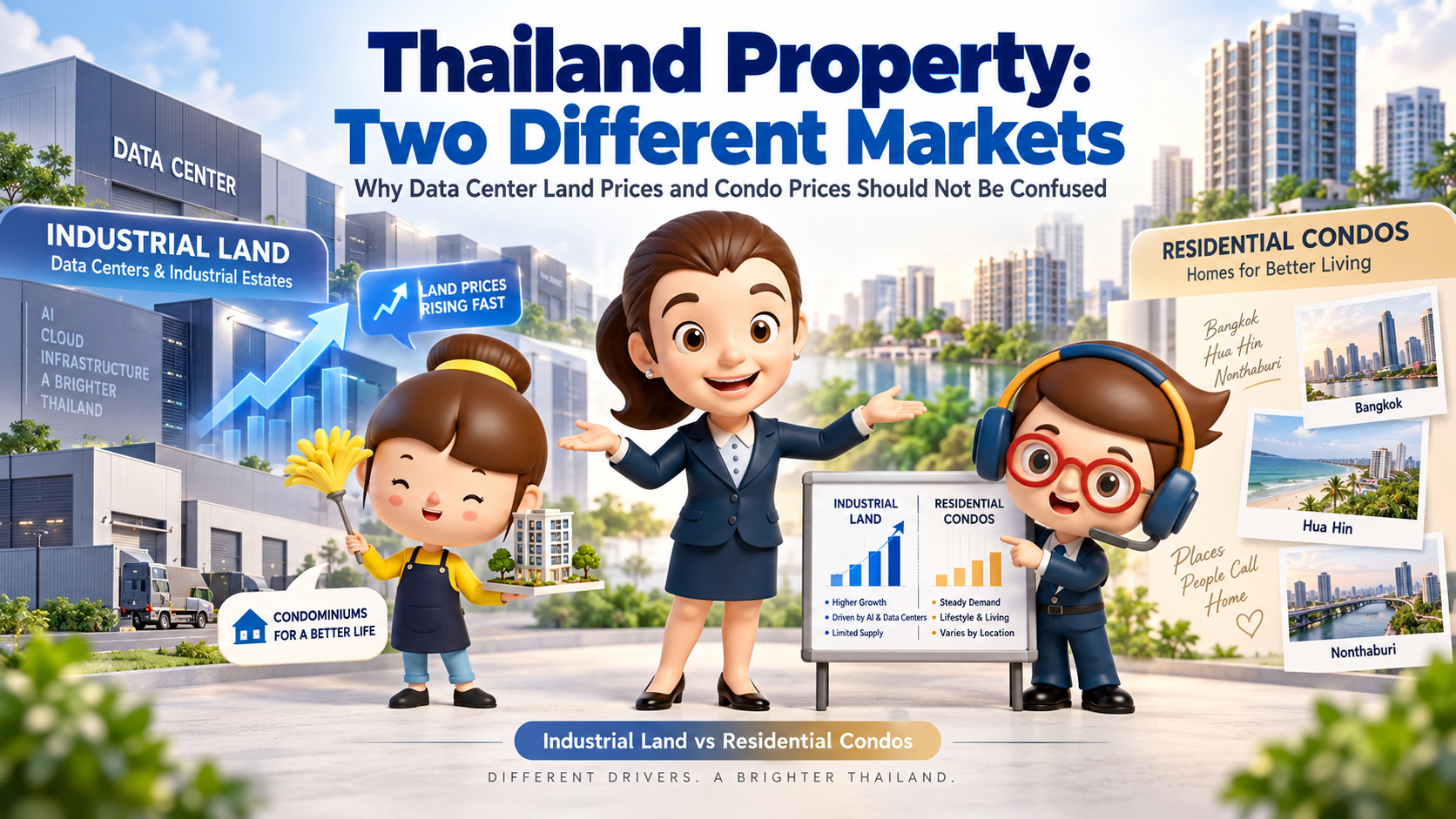
Thailand's Industrial Land Prices Jump 50%+ on Data Center Boom — What It Means for Bangkok and Hua Hin Condo Buyers in 2026
According to Thai property news outlet Prop2morrow (September 6, 2026), a surge in data center investment has pushed land prices in several core Thai industrial estates up by more than 50% in a single month. In the same window, several residential launches went live in Bangkok, Hua Hin and Nonthaburi, including Sansiri's fully-furnished Hua Hin condo project "HUB Hua Hin," starting around THB 1.19 million. BigHousekeeper explains why industrial land pricing and residential condo pricing are two separate markets that should not be conflated. One: What Actually Happened On September 6, 2026, Thai property news site Prop2morrow reported that land prices in several major Thai industrial estates have risen sharply — with some core plots up more than 50% in a single month — driven by a wave of data center investment. Industry commentary attributes this to growing cloud computing and AI compute demand, with international tech firms and data center operators accelerating capacity build-out in Thailand, repricing industrial land supply and demand. In the same period, several residential updates surfaced: Sansiri launched a fully-furnished condo project in Hua Hin, "HUB Hua Hin," starting around THB 1.19 million; developer 95E1 partnered with design brand Space Edition on a high-end Bangkok residential project built around a "collectible design" concept; and PROUD's "Wellness District" series expanded its fifth phase to Nonthaburi, on Bangkok's outer metro fringe. Two: Industrial Land ≠ Residential Condo Prices It's worth being precise here: the "50%+ land price" figure refers to industrial estate land used for data centers and logistics — bought mainly by institutional investors, tech companies, and industrial developers, not individual retail buyers. This is a different market from residential condos in Bangkok or vacation property in Hua Hin, which move on different drivers. Dimension Industrial land (data center/logistics) Residential condos Typical buyer Institutional investors, tech firms, industrial developers Individual owner-occupiers / investors Key driver Compute/cloud capex, land scarcity FX rates, tourism and expat housing demand, developer supply pace Representativeness Concentrated in specific industrial estate plots Varies widely by district, project, and building age We would caution against reading the industrial land figure as a signal that "Thai property prices are about to surge" broadly — these are two separate markets. Three: What This Means for Residential Buyers The data center investment wave itself is one signal of growing international capital confidence in Thailand's business environment — which is broadly consistent with Thailand's push toward a 2028 OECD membership bid, with anti-bribery reform cited as a key focus area of the current process (The Nation Thailand, September 7, 2026). Better governance transparency tends to support foreign investor confidence over the long run, but this is a macro-level signal — it does not mean any specific building or district is guaranteed to appreciate. Buying decisions should still come back to the specific project's location, developer track record, and product quality. Districts Worth Watching (indirect, macro-level signal) District Observation Greater Bangkok outer fringe (e.g. Nonthaburi) PROUD and other developers are pushing wellness-oriented residential concepts beyond the core city, suggesting rising demand absorption in outer districts Hua Hin and other coastal/resort markets Large developers like Sansiri continue launching fully-furnished, lower-entry-price vacation condos targeting both local and overseas buyers Myths to Avoid ❌ Treating "industrial land +50%" as proof that Thai residential prices are broadly surging — they are not the same market ❌ Viewing data center projects themselves as a retail property investment vehicle — these are institutional-grade land/plant transactions, not consumer residential products ❌ Reading a wave of new launches as "scarcity, buy now" — more launches usually means buyers have more products and prices to compare Four: What BigHousekeeper Does BigHousekeeper (泰国大管家) has operated in Bangkok and Pattaya property services since 2020, working in Chinese, English, and Thai. We help overseas buyers with viewings, transaction support, and post-purchase rental/property management, so decisions can be made with clearer information in a market that isn't always transparent. Five: FAQ Q1: Does this "50% industrial land jump" affect me as a regular condo buyer? A: Only indirectly. It reflects heat in the industrial/data-center land market specifically, not a signal that residential condo prices will move in tandem — the two markets run on different logic. Q2: Can foreigners buy the projects mentioned here? A: Condo projects like "HUB Hua Hin" can be purchased by foreigners under current Thai law, subject to the standard 49% foreign-ownership quota per building. Villas or landed houses cannot be held directly by foreigners — these typically require a Thai company structure or a long-term lease arrangement. Q3: What budget range does a THB 1.19 million starting price represent? A: That's roughly USD 33,000-34,000 at commonly cited exchange rates (for reference only — always check the live rate), which sits at the lower-entry end of the Hua Hin vacation condo market. Actual pricing varies by unit layout, floor, and view — confirm against the project's official price list. Q4: What's the rental yield on these new launches? A: As of publication, we have not seen verified rental yield data specific to these projects from a credible source, so we won't quote a percentage from memory. If yield matters to your decision, ask the developer or a local team for a projection that states an occupancy assumption, a reference year, and whether fees are deducted. Q5: Does buying property here get me a visa or residency? A: No. Property purchase does not by itself confer any visa status. Long-term residency options like the LTR visa or Thailand Privilege require a separate application. BigHousekeeper does not provide visa-agent services — we'd recommend handling visa planning through a licensed specialist separately from your property purchase. Q6: What do I need for an overseas wire transfer to buy property here? A: Generally you'll need to wire funds in foreign currency into Thailand and obtain a Foreign Exchange Transaction (FET) form from the receiving bank, which is required for title transfer and registration later. Confirm the exact document checklist with your bank and the project early — not at the last minute before closing. Q7: Is the data center investment boom likely to continue? A: That's a macro judgment call. Public information at this point only confirms the recent spike — there's no authoritative medium-term forecast available yet. Treat it as one signal of capital confidence in Thailand, not the sole basis for a purchase decision.2026-09-07 10:36:08